













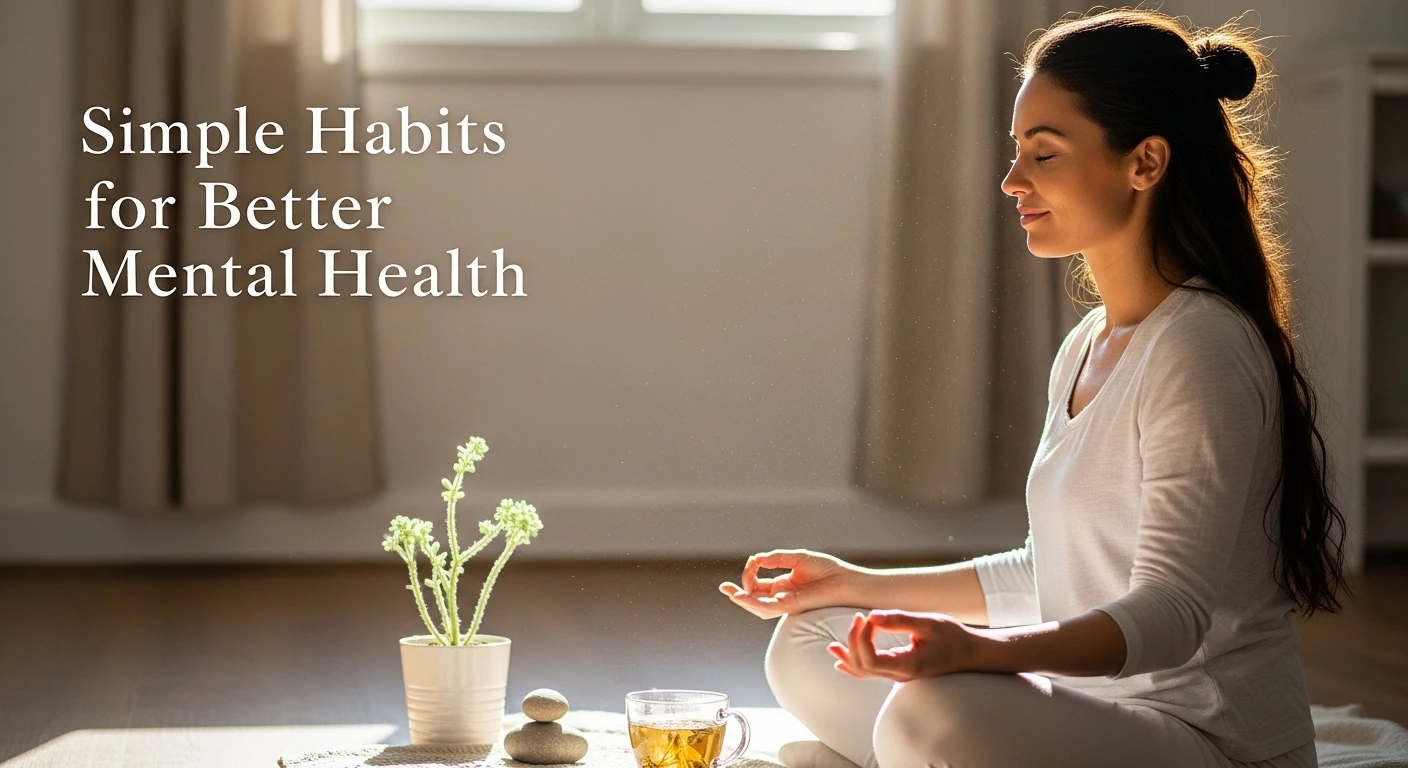
Simple habits for better mental health — like consistent sleep, daily movement, and intentional connection — are proven to reduce anxiety, improve mood, and build emotional resilience.
Introduction
You don’t need a dramatic lifestyle overhaul. Small, repeated actions practiced daily create the most lasting mental health improvements
Simple habits for better mental health are not complicated — but here’s what surprises most people: the smallest changes tend to produce the biggest results. According to the American Psychological Association, over 75% of Americans report experiencing moderate to high levels of stress regularly. That’s not a small number. That’s most of us.
Here’s the truth. Most people assume that fixing their mental health means therapy five days a week, expensive wellness retreats, or some radical personality shift. It doesn’t. What actually moves the needle is far less dramatic — and far more sustainable.
This guide breaks down exactly which daily habits work, who benefits most, what the latest research says, and how you can start today — without turning your entire life upside down.
What Is Mental Health — And Why Do Daily Habits Actually Matter?
Let me be blunt: mental health isn’t just the absence of a diagnosis. It’s the quality of how you think, feel, and function every single day. You can have zero clinical diagnoses and still feel chronically exhausted, anxious, or disconnected. That’s a mental health issue too — it just doesn’t have a label yet.
Here’s where daily habits come in.
Your brain is a creature of pattern. Neuroscience has shown us that repeated behaviors literally reshape the brain’s neural pathways — a process called neuroplasticity. When you consistently practice calming, grounding, or energizing habits, you’re not just “feeling better” in the moment. You’re physically rewiring how your brain responds to stress, setbacks, and uncertainty.
Now, this part catches people off guard: the habits don’t need to be long. They don’t need to be elaborate. A 10-minute walk. Eight hours of sleep. A single moment of genuine human connection. These things compound. Over weeks and months, they build a completely different baseline — one where anxiety doesn’t hit quite as hard, and joy comes a little easier.
“The brain’s ability to reorganize itself by forming new neural connections throughout life, in response to learning, experience, or environment.” — Under 30 words, plain English.
The science on this is not new. What IS new in 2026 is just how clearly researchers understand the dose and frequency required. More on that in the developments section.
American Psychological Association – Stress in America Report
Who Struggles With Mental Health? (More People Than You Think)
This surprises people. Mental health challenges don’t discriminate. They hit high-performing executives, stay-at-home parents, teenagers, retirees, and everyone in between. The World Health Organization estimates that 1 in 4 people globally will experience a mental health condition at some point in their lives.
I’ve seen this firsthand — someone can look completely “put together” on the outside while quietly managing anxiety, low mood, or emotional burnout every single day. The CEO running a successful company. The parent who’s always smiling at school pickup. The college student with a 4.0 GPA.
Where most people get burned is in the assumption that struggle equals weakness. It doesn’t. It means you’re human. And humans need maintenance — not just for their bodies, but for their minds.
What the data tells us specifically:
- Anxiety disorders affect over 40 million adults in the United States alone.
- Depression is now the leading cause of disability worldwide, per WHO.
- Burnout — officially recognized by WHO as an occupational phenomenon — is at record highs post-pandemic.
The populations most affected include young adults (ages 18–34), working mothers, caregivers, and people with high-pressure careers. But again — no one is exempt.
Who Can Benefit From These Habits?
Eligibility Criteria
Let’s be clear: you don’t need a diagnosis to benefit from building better mental health habits. These strategies work for:
- People currently managing anxiety, depression, or stress
- Those in therapy who want to reinforce their progress between sessions
- Anyone feeling emotionally flat, unmotivated, or mentally foggy
- People who are “fine” but want to stay fine — prevention matters
- Caregivers and parents managing emotional fatigue
Types of Challenges These Habits Address
- Chronic stress and work-related burnout
- Social anxiety and loneliness
- Poor sleep driven by an overactive mind
- Low mood and lack of motivation
- Emotional dysregulation (big reactions to small triggers)
- Digital overwhelm and doomscrolling addiction
If you’ve ever thought, “I just feel off, but I can’t explain why,” — this is for you too. That feeling has a name. It’s called languishing, and it’s more common than clinical depression right no,w according to researchers like psychologist Adam Grant.
[INTERNAL LINK: What Is Languishing? Signs You’re Neither Thriving Nor Struggling]
Simple Habits for Better Mental Health: The 2026 Breakdown
This is the heart of it. Let’s break this down properly — not a generic list, but a real look at what works, why it works, and how to actually do it.
1. Move Your Body — Even When You Don’t Feel Like It
Here’s the thing about exercise and mental health: you don’t need intense workouts. Research from Harvard Medical School confirms that 30 minutes of moderate aerobic exercise — brisk walking, cycling, dancing — is as effective as antidepressants for mild to moderate depression in some populations.
But even 10 minutes counts. Movement triggers endorphins, reduces cortisol (the stress hormone), and improves sleep quality. The keyword is consistency, not intensity.
Let me give you a quick example. A client I spoke with — a 34-year-old nurse working double shifts — started a 15-minute morning walk before work. Within three weeks, she told me her anxiety “felt quieter.” She hadn’t changed anything else. Just the walk.
2. Protect Your Sleep Like It’s Non-Negotiable
Sleep deprivation and mental health decline are so tightly linked that some researchers call poor sleep a “risk multiplier” — meaning it makes every other mental health challenge worse. Anxiety becomes sharper. Emotional regulation becomes harder. Motivation drops off a cliff.
Simple sleep hygiene wins:
- Same bedtime and wake time every day (yes, weekends too)
- Phone out of the bedroom, or at minimum, face down and silenced
- Room temperature between 65–68°F for optimal sleep quality
- No caffeine after 2 PM
Be careful here — many people fix their anxiety by fixing their sleep first. Don’t underestimate it.
3. Practice Intentional Connection
Social isolation is now classified by the U.S. Surgeon General as a public health epidemic. The mental health impact of loneliness is comparable to smoking 15 cigarettes a day. That’s not a metaphor — that’s the actual research.
Intentional connection doesn’t mean filling your calendar with social events you resent. It means quality over quantity. One real conversation a week can shift your baseline significantly. Text a friend. Call a parent. Have coffee with someone who makes you feel seen.
This is where it gets messy for most people — they wait until they feel social to reach out. But reaching out is what creates the feeling. Do it first. Feel better second.
4. Limit Doomscrolling and News Overload
This one’s uncomfortable. Social media platforms are engineered — literally designed by behavioral psychologists — to hijack your dopamine system. Every scroll is a potential reward. And your brain can’t stop chasing it.
Furthermore, the content you consume shapes your emotional state. A 2023 study published in the Journal of Experimental Psychology found that people who reduced social media use by 30 minutes a day reported significant improvements in well-being after just two weeks.
Try this: set a screen time limit on your phone. Start with 45 minutes per day total for social media. Then notice how you feel after a week.
5. Build a Wind-Down Ritual
Your nervous system doesn’t have an “off” switch — but you can coax it toward calm. A consistent wind-down ritual signals to your brain that it’s safe to relax. This could be:
- Making herbal tea and reading fiction for 20 minutes
- Light stretching or yoga
- Journaling three things you’re grateful for
- Listening to calming music
The ritual itself matters less than the repetition. Consistency builds the neural association. After a few weeks, your brain begins to relax simply because the ritual has started.
6. Talk to Yourself With Compassion
This is where most people need to do the most work — and the most people resist it. Self-criticism feels productive. “If I’m harsh on myself, I’ll do better.” But research from Dr. Kristin Neff at the University of Texas consistently shows the opposite: self-compassion leads to greater resilience, higher motivation, and better mental health outcomes than self-criticism.
Here’s a practical tool. When you make a mistake, ask yourself: What would I say to my best friend if this happened to them? Then say exactly that — to yourself.
It feels strange at first. It works anyway.

Key Developments: What Mental Health Research Tells Us in 2026
Mental health science has moved fast in recent years. Here are the most important updates that change how we think about building better habits:
Micro-habits are officially validated. Research published in Nature Human Behaviour in late 2024 confirmed that habits as short as 5–10 minutes, practiced daily, produce measurable neurological changes within 66 days on average (extending earlier research from UCL).
Social prescribing is going mainstream. In the UK and increasingly in the US, doctors are now “prescribing” social activities — community groups, walking clubs, volunteer work — as legitimate treatment for anxiety and depression. It works. And it’s free.
Sleep is the new therapy. Matthew Walker’s ongoing research at UC Berkeley and new 2025 data continue to show that improving sleep quality reduces symptoms of anxiety and depression more reliably than almost any other non-pharmaceutical intervention.
Digital detox is becoming clinical. Several hospital systems now formally recommend structured digital detox periods as part of mental health treatment plans — not just wellness advice.
In addition, the American Psychiatric Association updated its clinical guidelines in 2025 to formally include lifestyle interventions — including exercise, sleep, and nutrition — as first-line recommendations for mild to moderate mood disorders.
World Health Organization – Mental Health Action Plan
What Can You Realistically Expect? (Honest Outcomes)
Let me be honest with you here, because most wellness content sets unrealistic expectations.
You will not feel dramatically better in 48 hours. But within 2–4 weeks of consistent habit practice, most people report:
- Improved sleep quality
- Reduced frequency of anxious thoughts
- More stable mood throughout the day
- Better ability to handle stress without spiraling
- Increased energy and motivation
Within 2–3 months, the changes become structural. You’re not just “feeling better” — you’ve built a new baseline. Stressful events still happen, but your recovery time shortens dramatically.
Importantly, these habits are complementary to professional care — not a replacement. If you’re managing a diagnosed condition, continue working with your provider. These habits will amplify the results of therapy and, where applicable, medication. They don’t compete with treatment — they accelerate it.
How To Start: A Step-by-Step Action Plan
Don’t try to implement everything at once. That’s the fastest way to quit. Here’s a sustainable approach:
Step 1: Choose ONE habit. Pick the one that feels most accessible — not the most dramatic. If sleep is a mess, start there. If you haven’t moved your body in weeks, start with a 10-minute walk.
Step 2: Anchor it to an existing routine. Habits stick when they’re attached to something you already do. Walk right after your morning coffee. Journal right before you brush your teeth at night.
Step 3: Start smaller than you think you need to. Five minutes of journaling beats zero minutes every time. Two minutes of deep breathing is better than a meditation session you never start.
Step 4: Track it simply. A checkmark on a paper calendar is enough. Don’t buy an app. Just mark the days you showed up.
Step 5: Add a second habit after 3 weeks. Only after your first habit feels automatic should you layer in another. This is where most people go wrong — they add too much, too fast.
Step 6: Be kind when you miss a day. Missing one day doesn’t break a habit. Missing two days in a row starts to. So the rule is simple: never miss twice.

Harvard Health – Exercise and Depression
Create a “Wind-Down” Ritual
Your brain loves predictability. A simple evening ritual — even just 15-20 minutes — signals to your nervous system that it’s time to relax. This could be making a cup of tea, reading a few pages of a book, stretching, or journaling. Whatever feels calming to you.
The ritual itself isn’t magic. The consistency is.
Limit Your News and Social Media Intake
This one’s uncomfortable but important. Doomscrolling is real, and it’s doing a number on all of us. You don’t have to go off the grid — just be intentional. Set a time limit, avoid social media first thing in the morning, and notice how you feel after you scroll vs. after you read a book or take a walk.
Doing something you enjoy daily can lead to better mental health.
Your feed is not the whole world. It just feels that way.
In the pursuit of better mental health, remember that small changes matter.
Ultimately, every step towards better mental health is significant.
Do One Thing Just for You, Every Day
Not for your boss. Not for your family. Not for your to-do list. Something small that brings you joy — a hobby, a walk, a song you love, a great cup of coffee enjoyed slowly. These tiny moments of pleasure add up and remind you that life isn’t just about productivity.
The Bottom Line
Better mental health doesn’t have to come from a radical overhaul. It comes from small, intentional choices made consistently over time. Pick one habit from this list — just one — and try it for a week. See what happens.
Your mental health is worth the effort. And the effort doesn’t have to be as big as you think. 💙
Frequently Asked Questions
Q: What are the simplest habits for better mental health I can start today? A: Start with these three: get 7–9 hours of sleep, take a 10-minute walk outside, and limit social media to 45 minutes per day. These three alone — done consistently — can meaningfully reduce anxiety and improve mood within 2–4 weeks. No equipment, no cost, no overhaul required.
Q: How long does it take for mental health habits to make a difference? A: Most people notice small improvements within 1–2 weeks. More significant changes — better mood stability, reduced anxiety, improved sleep quality — typically emerge after 4–6 weeks of consistent practice. Research suggests 66 days is the average time for a habit to become automatic.
Q: Can daily habits replace therapy or medication for mental health? A: No — and it’s important to be clear about this. Daily habits are powerful complements to professional care, not replacements. If you have a diagnosed mental health condition, work with a qualified provider. Habits can enhance the results of therapy and medication, but they don’t substitute for clinical treatment.
Q: What is the single most impactful habit for mental health? A: Sleep. Research consistently shows that improving sleep quality has a more immediate and measurable impact on mood, anxiety, and emotional regulation than almost any other single habit. If you only fix one thing, fix your sleep first.
Q: I feel fine — do I still need mental health habits? A: Absolutely. Mental health habits aren’t only for people in crisis. They’re preventive medicine. Building strong habits when you feel well creates resilience for when life gets hard — and life will get hard eventually. Think of it like going to the gym before you need to lose weight.
Q: How do I stay consistent with mental health habits when life gets busy? A: Anchor your habits to existing routines so they require no extra decision-making. Start small enough that skipping feels worse than doing it. And remember the “never miss twice” rule — one missed day is human; two in a row is where habits break down. Keep the bar low enough to always clear it.
Q: Can better mental health habits help with anxiety specifically? A: Yes — significantly. Regular movement, consistent sleep, limiting news consumption, and practicing self-compassion are all evidence-based strategies for reducing anxiety symptoms. For generalized anxiety disorder or panic disorder, these habits work best alongside professional support.
Conclusion
Here’s what this all comes down to: simple habits for better mental health aren’t about perfection — they’re about direction. You don’t need to do everything on this list. You need to pick something real, start smaller than feels necessary, and show up for it consistently.
The research is detailed. Movement, sleep, connection, and intentional self-care change your brain. Not metaphorically — literally. And the beauty of it is that none of this requires a gym membership, a therapist’s waiting list, or a complete personality transplant.
Start with one habit. Give it three weeks. Then build from there. Your mental health is not a luxury or a project to tackle “when things slow down.” It’s the foundation everything else rests on.
Take care of it as it matters. Because it does.
Let’s be real — when most people hear “improve your mental health for better mental health,” they picture someone waking up at 5 AM, meditating for an hour, journaling three pages, running 10K, and drinking a green smoothie before 7 AM. Exhausting, right? To achieve better mental health, small changes can be just as effective.
The good news? You don’t need a dramatic transformation to feel better. Small, consistent habits can make a huge difference — and the best part is, they’re actually doable.
Better mental health can be supported by simple lifestyle changes that we can all implement.
Here are some simple habits that genuinely work:
asy to feel “connected” while actually feeling very alone.
Schedule a catch-up with a friend this week. Put it in your calendar like it’s a meeting. Because it matters just as much.