









I’ve spent fifteen years training clients and competing myself, and I can tell you that most people approach arm training completely backward. They walk into the gym, head straight for the dumbbell rack, and start curling whatever they can lift. Then they wonder why their arms stay stubbornly the same size month after month. Building impressive triceps and biceps isn’t about doing more curls or training until you can’t lift your arms. It’s about understanding how these muscles actually work and choosing exercises that target them through the right angles with proper tension.
“Stronger arms don’t come from doing more reps—they come from doing the right work with intention, precision, and patience”
The best exercises for building triceps and biceps include close-grip bench press, barbell curls, skull crushers, hammer curls, tricep dips, concentration curls, and overhead tricep extensions. These movements target all three tricep heads and both bicep heads through varied angles and grips for complete arm development.“
He added: “As the changes have come, the diet has tightened up … She’s made better choices when she eats. She’s been more conscious
Here’s what I wish someone had told me when I started training arms seriously. Your triceps actually make up about two-thirds of your upper arm mass, which means if you want bigger arms faster, you need to stop obsessing over bicep curls and start prioritizing tricep work. Compound movements like the close-grip bench press will build more overall size than doing endless isolation exercises. Training both muscle groups twice per week with at least 48 hours of rest between sessions gives you the sweet spot for growth without burning yourself out. Progressive overload, which means gradually adding more weight or doing more reps over time, is what actually drives your muscles to grow bigger and stronger. And perhaps most importantly, proper form matters more than the numbers on the weight plates because if you’re swinging and using momentum, you’re not actually working the muscles you think you are.
“You don’t build great arms by chasing heavy weights—you build them by mastering the basics and repeating them with relentless consistency”
Why Triceps Matter More Than You Think
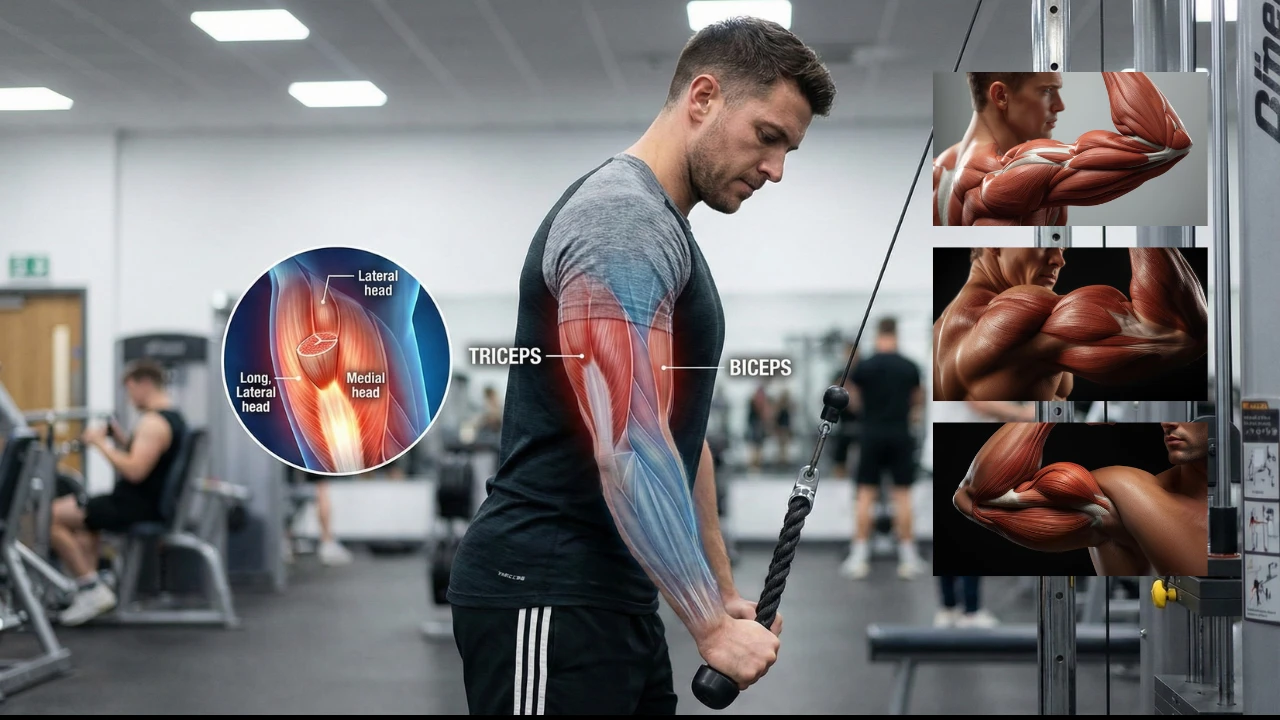
Let me share something that changed my entire approach to arm training. I had this client, Jake, who came in wanting bigger arms. Like most people, he was doing bicep curls three times a week and maybe throwing in some tricep pushdowns as an afterthought. After three months, his arms had barely grown half an inch. Then we flipped the script and made triceps the priority, and his arms grew an inch and a half in the next three months. Why? Your triceps comprise roughly 60 to 65 percent of your upper arm mass. They’re literally the bigger muscle group, yet most people treat them like a side dish rather than the main course.
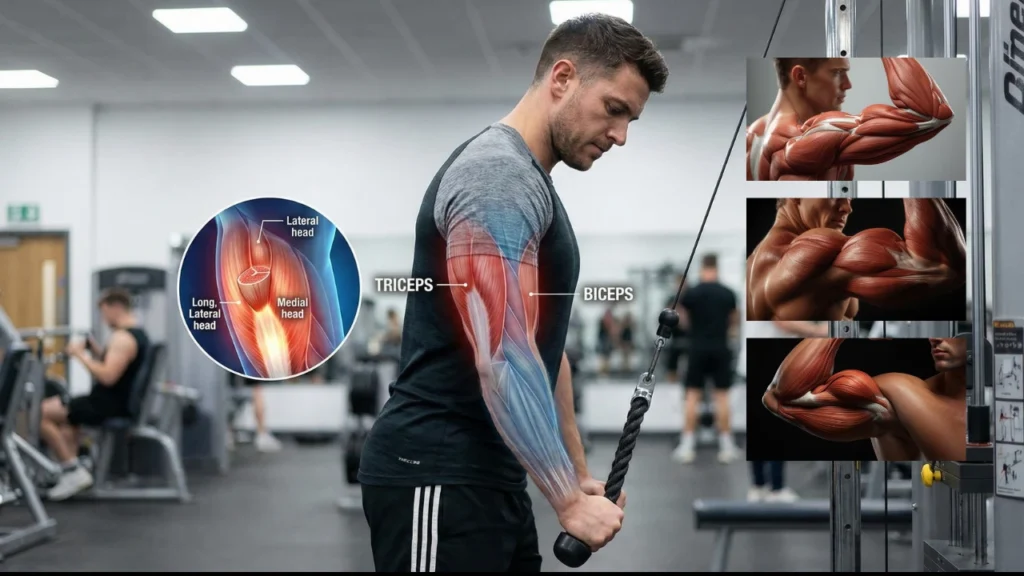
Your triceps have three distinct heads working together. There’s the long head, which runs down the back of your arm and creates that impressive sweep when it’s developed. The lateral head sits on the outer part and gives you that horseshoe shape when you flex. And the medial head sits underneath, providing thickness and stability. Each head responds better to certain angles and movements, which is why doing just one tricep exercise never gives you complete development. When I learned to target each head specifically, my arms finally started filling out my sleeves the way I’d always wanted.
Think about every pushing movement you do in life. Opening a heavy door, pushing yourself up from the ground, pressing a barbell overhead. That’s all triceps. They’re functional, powerful, and, when developed properly, they transform how your entire upper body looks. Strong triceps also dramatically improve your bench press numbers because they handle the lockout portion of the movement. I’ve seen people add thirty pounds to their bench just by strengthening their triceps through dedicated work.
The Science Behind Bicep Development
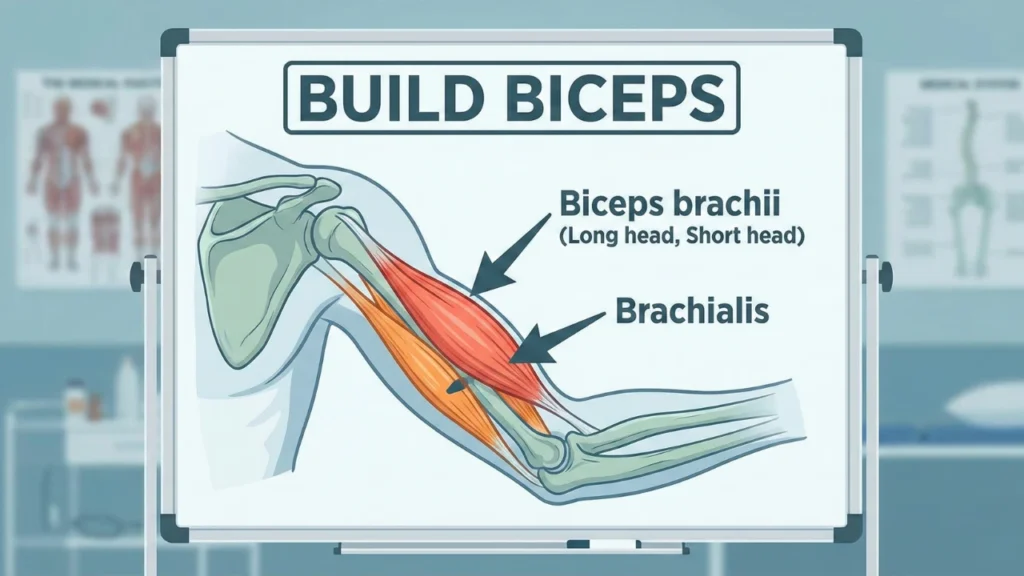
Now let’s talk about why your biceps might not be responding the way you want them to. Your biceps consist of two heads that everyone knows about. The long head creates that peaked appearance when you flex your arm, the one that looks impressive in photos. The short head adds width to your arm when someone’s looking at you from the front. But here’s what most people miss: underneath those two heads sits a muscle called the brachialis that nobody talks about enough. When you develop your brachialis, it literally pushes your biceps up from underneath, making them look fuller and more developed even when you’re not flexing.
I learned this lesson the hard way during my first year of serious training. I was curling heavy dumbbells, swinging them up with momentum, feeling like I was doing something productive. My biceps stayed almost the same size. Then an older lifter at my gym pulled me aside and showed me how to curl properly with lighter weight, and suddenly, I started growing. The difference? I was actually using my biceps instead of my lower back, shoulders, and hip momentum to move the weight.
Your biceps are relatively small muscles compared to your back or legs, which means they fatigue quickly under heavy loads. They respond better to moderate weights moved through a full range of motion with a controlled tempo. When you watch someone swinging fifty-pound dumbbells with terrible form, they’re not building impressive biceps. They’re risking injury and wasting their time. The person curling thirty-pound dumbbells with perfect form and three-second lowering phases will build more muscle every single time.
“Biceps don’t grow from ego—they grow from control. The slower you move the weight, the faster your arms start to change.”
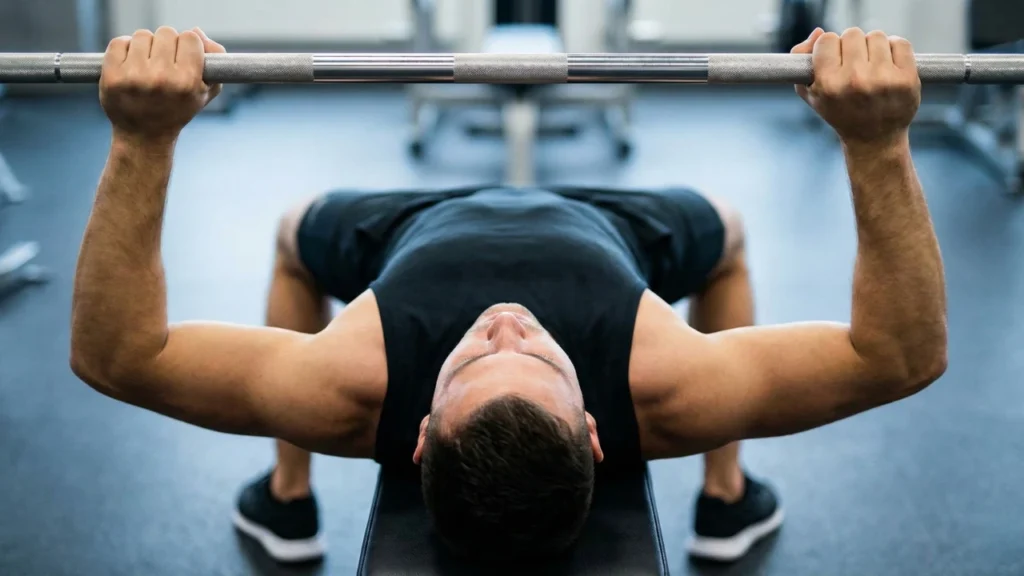
Exercise 1: Close-Grip Bench Press for Tricep Mass
If I could only choose one exercise to build tricep size and strength, this would be it. The close-grip bench press lets you move serious weight through a natural pressing pattern while hammering all three tricep heads simultaneously. Position your hands on the barbell slightly narrower than shoulder width. You don’t want them touching in the middle because that puts too much stress on your wrists. Instead, keep them just inside shoulder width for the perfect balance of tricep engagement and joint safety.
When you lower the bar, bring it down to your mid-chest area while keeping your elbows tucked at roughly 45 degrees from your body. This angle is critical. If your elbows flare out wide like a regular bench press, you shift the work back to your chest and shoulders. If you tuck them too tight against your sides, you create awkward joint angles that can lead to elbow pain. That 45-degree angle keeps maximum tension on your triceps where you want it.
Start with three sets of six to eight reps using a weight that challenges you while letting you maintain perfect form throughout every repetition. When you can hit eight solid reps on all three sets, add five pounds to the bar the next week. This gradual progression, session after session, is what builds impressive triceps over time. I’ve watched my own close-grip bench go from 135 pounds for shaky sets to 225 pounds for solid reps over two years, and my triceps grew in direct proportion to those strength gains.
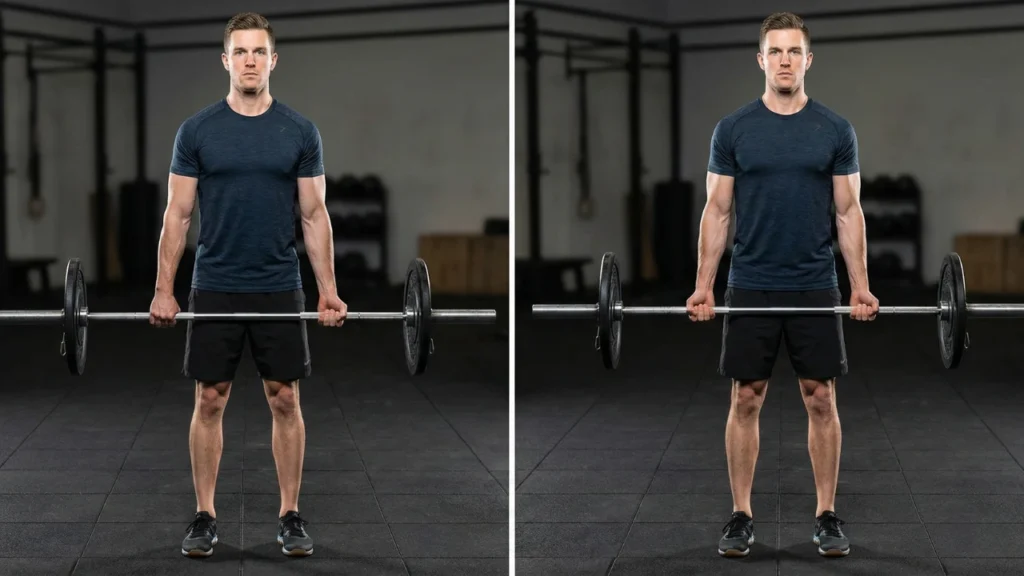
Exercise 2: Barbell Curls for Bicep Foundation
Nothing builds overall bicep mass quite like standing barbell curls performed with strict form. I’m emphasizing “strict form” because I see this exercise butchered more than almost any other movement in the gym. Stand with your feet about shoulder-width apart, grip a straight bar with your palms facing forward at shoulder width, and here’s the key: lock your upper arms against your sides like they’re glued there. They should not move forward, backward, or anywhere else during the entire set.
Curl the weight up by bending only at your elbows, squeezing hard at the top position for a full second, then lowering the weight back down with control over about three seconds. That eccentric lowering phase is where most of the muscle-building stimulus happens. When you drop the weight quickly, you’re throwing away half the effectiveness of the exercise. I learned this from a strength coach who made me do barbell curls with a five-second lowering phase for a month, and my biceps grew more in that month than the previous six months combined.
The barbell allows you to overload your biceps with more total weight than dumbbells because both arms are working together on the same implement. This heavier load creates more mechanical tension, which signals your body to build bigger, stronger muscles to handle the stress. Aim for three sets of eight to twelve reps, and focus on that slow, controlled lowering phase. If you find yourself leaning back or swinging your hips to get the weight up, that’s your body telling you the weight is too heavy. Drop it by ten pounds and do it right. Your ego might take a small hit, but your biceps will actually grow.
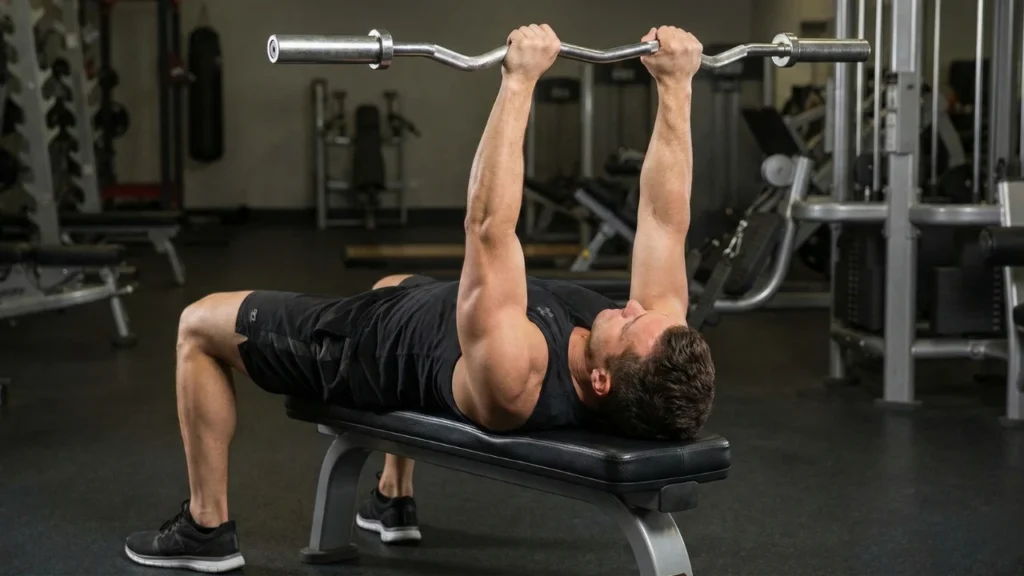
Exercise 3: Skull Crushers for Tricep Definition
Skull crushers earned their intimidating name from the bar path, but when you perform them correctly, they’re one of the safest and most effective tricep builders available. Lie flat on a bench holding an EZ-curl bar directly above your chest with your arms extended. Now here’s where most people make their first mistake: they lock their elbows completely straight. Don’t do that. Keep a slight bend in your elbows at the top to maintain constant tension on your triceps throughout the set.
Lower the weight toward your forehead by bending only at your elbows while keeping your upper arms completely stationary and perpendicular to the floor. This is harder than it sounds because your natural instinct is to let your upper arms drift back toward your head, which turns the exercise into a pullover and takes tension off your triceps. Fight that urge. Keep those upper arms locked in position, and you’ll feel an incredible stretch in your triceps at the bottom of the movement.
That deep stretch at the bottom is what makes skull crushers so effective for building the long head of your triceps. When you extend back up to the starting position, stop just before you lock out completely to keep tension on the muscle. I typically use a weight I can control for three sets of ten to fifteen reps. If your elbows start hurting with a straight bar, switch to dumbbells or an EZ-curl bar, which allows your wrists to rotate into a more natural position. I’ve trained hundreds of people through skull crushers, and the ones who master the form always develop that detailed tricep definition that makes arms look complete.
Exercise 4: Hammer Curls for Complete Bicep Growth
[Insert image — hammer curl technique emphasizing brachialis development with keyword arm exercises]
Hammer curls changed everything about how my arms looked, and most people don’t even realize what makes them special. Hold dumbbells at your sides with your palms facing each other in what’s called a neutral grip. Curl one dumbbell up while keeping your palm facing inward throughout the entire movement, lower it with control, then alternate to the other arm. Simple movement, profound results.
The magic of hammer curls lies in that neutral grip position. Regular curls with palms facing up primarily target your biceps. But when you rotate your wrists to that neutral position, you shift significant work onto your brachialis and brachioradialis muscles. Your brachialis sits underneath your biceps, and here’s why this matters: when you develop your brachialis through hammer curls, it literally pushes your biceps up from underneath, making them look bigger even when you haven’t added any direct size to the biceps themselves.
I remember training a client whose biceps just wouldn’t grow with regular curls. We added hammer curls twice per week, and within two months, his arms looked noticeably fuller and thicker. He hadn’t gained much actual bicep size, but his brachialis development had pushed everything up and out. Perform three sets of ten to twelve reps per arm with deliberate tempo, and focus on keeping that neutral grip position throughout. This exercise also builds serious forearm and grip strength, which improves your performance in every pulling exercise you do.
Exercise 5: Tricep Dips for Functional Strength
[Insert image — man performing parallel bar dips for triceps with keyword tricep dips]
Bodyweight dips humble almost everyone the first time they try them properly. Using parallel bars or the edge of a stable bench, support your entire bodyweight on straight arms. Lower your body by bending your elbows to roughly 90 degrees while keeping your torso relatively upright and your elbows pointed back behind you, not flaring out to the sides. Then press yourself forcefully back to the starting position without locking your elbows completely at the top.
What makes dips so valuable is that you’re moving your entire bodyweight through a full range of motion, which creates significant load on your triceps. For most people, that’s between 140 and 220 pounds of resistance right from the start. This compound movement also engages your chest and shoulders as stabilizers, making it one of the most efficient upper body exercises you can do. When I first started training, I could barely do five bodyweight dips. Two years later, I was doing sets of fifteen with a forty-five-pound plate hanging from a belt around my waist.
Start with three sets to failure, which for most people means somewhere between eight and fifteen reps. If you can’t do at least five bodyweight dips yet, use an assisted dip machine or place your feet on a bench behind you to reduce the load. Once you can confidently bang out fifteen clean bodyweight dips, start adding external weight using a dip belt or by holding a dumbbell between your feet. The progressive overload from dips transfers directly to bigger, stronger triceps that show in every shirt you wear.
Exercise 6: Concentration Curls for Peak Development
[Insert image — concentration curl isolating bicep peak with keyword biceps building]
Concentration curls isolate your biceps in a way that almost no other exercise can match. Sit on the end of a bench with your legs spread wide, holding a dumbbell in one hand. Brace your elbow firmly against your inner thigh, then curl the weight up while keeping your upper arm completely motionless. Squeeze hard at the top for a full two seconds before lowering slowly back down.
I learned to love concentration curls from an old-school bodybuilder who explained that your biceps have minimal help from surrounding muscles in this position. Your arm is braced against your leg, so you can’t generate momentum. You’re seated, so you can’t use your lower body. And that isolation forces every single muscle fiber in your bicep to contribute to moving the weight. The result is that peaked, ball-shaped bicep development that makes your arms look impressive when you flex.
This is not an exercise where you try to use heavy weight. I typically use dumbbells that are twenty to thirty percent lighter than what I’d curl standing because the isolation makes the movement significantly harder. Perform three sets of twelve to fifteen reps per arm, and really focus on feeling that mind-muscle connection. Squeeze at the top like you’re trying to touch your bicep to your forearm, even though anatomically that’s impossible. That intense contraction at the peak of the movement is what builds that coveted bicep peak that stands out even under a sleeve.
Exercise 7: Overhead Tricep Extensions for Long Head Activation
[Insert image — overhead dumbbell extension stretching tricep long head with keyword triceps and biceps exercises]
The overhead position for tricep work targets your long head in a way that no other angle can replicate. Stand or sit while holding a single dumbbell with both hands overhead, arms extended. Lower the weight behind your head by bending only at your elbows while keeping your upper arms as vertical as possible and close to your ears. Extend back up without locking out completely at the top.
Here’s why the overhead position is so important for complete tricep development. Your tricep long head is unique because it originates at your shoulder blade, making it the only tricep head that crosses both your shoulder and elbow joints. When you position your arms overhead, you place the long head under maximum stretch, and research consistently shows that training muscles in their stretched position creates more growth than training them in shortened positions.
I use a weight that allows me to complete three sets of twelve to fifteen controlled reps, and I prioritize feeling that deep stretch at the bottom position over moving heavy weight. When I first added overhead extensions to my routine, I noticed that my triceps started developing that complete, three-dimensional look instead of just appearing flat from certain angles. Focus on keeping your elbows pointing forward rather than letting them flare out to the sides, which shifts tension away from your triceps onto your shoulders. If you feel your elbows drifting apart as you fatigue, that’s your signal to end the set rather than continuing with compromised form.
Real Results: A Case Study in Arm Transformation
[Insert image — before and after arm development transformation with keyword build massive arms]
Let me tell you about Marcus because his transformation perfectly illustrates what happens when you stop training randomly and start training smart. Marcus walked into the gym with thirteen-inch arms after an entire year of what he called “working out.” When I asked him to show me his arm routine, he demonstrated the same three exercises he’d been doing for months: standing barbell curls, dumbbell curls, and cable pushdowns. He curled almost every time he trained but pressed heavy weights maybe once per week if that.
His biceps had some modest development from all that curling work, but his triceps completely lacked size and definition. From the side, his arms looked thin because he had no tricep mass filling out the back of his upper arm. We sat down and completely restructured his approach around the seven exercises I’ve shared with you here. He started prioritizing close-grip bench press and dips while balancing his bicep work with strategic variety that hit his arms from multiple angles.
After twelve weeks of following this program twice per week, Marcus’s arms measured just over fifteen inches with visible separation between the muscle heads. But the measurements only tell part of the story. His arms looked completely different. They had shape from every angle. When he pressed something overhead, you could see that horseshoe tricep definition. When he flexed his biceps, they had an actual peak instead of just slight swelling.
The real breakthrough came when Marcus accepted that tricep work mattered more for overall arm size than endless bicep curls. He made close-grip bench press and weighted dips his priority movements, tracking every single workout in a training log. His close-grip bench press climbed from 135 pounds for shaky sets to 175 pounds for solid eights. His dips progressed from eight bodyweight reps to fifteen reps with a twenty-five-pound plate hanging from a belt. His barbell curls improved from sixty-five pounds to ninety pounds for eight clean reps with zero momentum.
But here’s what really made the difference, and this is what I emphasize with every client I train: consistency and recovery. Marcus trained his arms Monday and Thursday every single week, which gave him 72 hours between sessions for complete recovery. He consumed adequate protein at every meal, slept a minimum of eight hours nightly, and never trained arms on back-to-back days no matter how eager he felt. Intelligent programming beats random effort every single time.
When to Seek Professional Guidance
Most people can safely perform these exercises by following proper form cues and starting with conservative weights that let them master the movement patterns. I always tell people to check their ego at the door and use weights that feel almost too light for the first few workouts. However, certain situations absolutely warrant professional guidance from a certified personal trainer or strength coach who knows what they’re doing.
If you experience sharp pain during any movement that goes beyond normal muscle fatigue, stop immediately and get someone qualified to watch you perform the exercise. Sharp pain is your body’s warning system telling you something is wrong. I’ve seen people push through pain only to end up with injuries that kept them out of the gym for months. A qualified trainer can assess your form, identify what’s causing the issue, and provide modifications that let you keep training safely.
Previous injuries to your shoulders, elbows, or wrists require modified approaches that most people can’t figure out on their own. I’ve worked with clients who had rotator cuff surgeries, tennis elbow, and carpal tunnel issues. In every case, we found exercise variations and grip modifications that let them build impressive arms without aggravating their old injuries. A good coach evaluates your individual movement patterns, identifies compensations you might not even realize you’re making, and prescribes alternatives that work around your limitations.
Similarly, if you follow this program consistently for more than four weeks without adding any weight or reps to your lifts, something in your approach needs adjustment. Maybe you’re not recovering adequately between sessions. Maybe your nutrition isn’t supporting muscle growth. Maybe you’re using too much momentum instead of strict form. A coach can diagnose these programming issues that you might miss when evaluating your own training.
Frequently Asked Questions
How often should I train triceps and biceps for maximum growth?
Training your arms twice per week hits that sweet spot where you provide enough stimulus to trigger growth without beating them up so badly they can’t recover. I’ve experimented with everything from training arms every day to training them once per week, and twice per week consistently produces the best results for most people. Space your sessions at least 48 to 72 hours apart, like doing arms on Monday and Thursday or Tuesday and Friday. Each session should include two to three tricep exercises and two to three bicep exercises with three to four sets each. This frequency balances the volume and intensity your arms need to grow without pushing them into that overtrained state where they just stay sore and don’t get bigger.
Can I build big arms with just bodyweight exercises?
Bodyweight exercises like dips, close-grip pushups, and chin-ups can absolutely build impressive arm development, especially when you’re first starting out. I’ve trained people who built fifteen-inch arms using primarily bodyweight movements. However, here’s the reality: progressive overload eventually requires adding external resistance. Your muscles need increasing tension over time to continue growing bigger and stronger. Once you can crank out twenty or thirty bodyweight dips, you’ve developed endurance more than you’re building additional size. At that point, you need to add weight through a dip belt, weight vest, or by holding a dumbbell between your feet. Bodyweight training works excellently as a foundation, especially when you combine it with strategic progressions like slowing your tempo or adding pauses in the stretched position.
Why aren’t my arms growing despite regular training?
This question comes up all the time, and the answer usually falls into one of three categories. First, you might not be providing enough progressive overload. If you’re curling the same twenty-five-pound dumbbells for the same ten reps that you did three months ago, your arms have zero reason to grow. Your body adapts to stress, so you must consistently add weight or reps to challenge your muscles beyond their current capacity. Second, you might not be recovering adequately. Arms need 48 to 72 hours between dedicated training sessions to repair and grow. If you’re hitting them hard every day, they’re constantly in a state of breakdown without time to rebuild bigger. Third, your nutrition might not support muscle growth. Building muscle requires eating slightly more calories than you burn with adequate protein intake, typically 0.8 to 1 gram per pound of bodyweight daily. You can train perfectly, but if you’re not feeding your body the raw materials it needs to build muscle tissue, growth simply won’t happen.
Should I train biceps or triceps first in my workout?
Train whichever muscle group is weaker or more important to your goals first in your workout when you have the most energy and mental focus. For most people seeking bigger arms, that means prioritizing triceps because they comprise more overall mass. If your triceps are significantly lagging behind your biceps in development, hit them first when you’re fresh. However, if your biceps are clearly underdeveloped compared to your triceps, flip the order and train biceps first. Regardless of which muscle group you prioritize, always perform compound movements like close-grip bench press before isolation exercises like cable pushdowns. This ensures you can move the heaviest weights possible on the movements that build the most overall size.
Do I need different exercises for different tricep heads?
While every tricep exercise works all three heads to some degree, certain movements definitely emphasize specific heads more than others. Overhead exercises like overhead extensions target the long head through maximum stretch because of how that head originates at your shoulder blade. Pressing movements like close-grip bench press emphasize the lateral head, which is that outer portion that creates the horseshoe shape. Close-grip exercises and pushdowns tend to work the medial head more directly. Including exercises from each category in your routine ensures complete tricep development instead of leaving obvious weak points in your physique. I learned this from experience when I spent six months doing only pushdowns and close-grip pressing. My lateral and medial heads developed nicely, but my long head lagged behind until I added overhead work. Within two months of adding overhead extensions, my triceps finally looked complete from every angle.
How much weight should I use for arm exercises?
Select weights that allow you to complete your target rep range with proper form while reaching near-failure on your final set. Near-failure means you could maybe squeeze out one more rep with perfect form, but not two or three more. For compound movements like close-grip bench press and dips, aim for six to eight reps with heavier loads that really challenge you. For isolation exercises like curls and extensions, use moderate weights for eight to fifteen reps with controlled tempo. If you can easily exceed the upper end of your rep range, like knocking out twenty reps when you were aiming for fifteen, increase the weight by five to ten pounds next session. The specific number on the dumbbell or barbell matters far less than whether that weight challenges your muscles to work hard while letting you maintain strict form throughout every repetition.
Can I train arms on the same day as chest or back?
Training arms after your chest or back work makes efficient use of your gym time because your arms are already pre-activated and pumped from all the pressing or pulling you just did. Your triceps work hard during chest exercises, and your biceps assist during back exercises, so adding dedicated arm work at the end creates a comprehensive training stimulus. However, this pre-fatigue reduces the absolute weight you can handle during your direct arm exercises. If arm development is a major priority for you, train them on a completely separate day when they’re fresh and you can give them your full effort. Otherwise, adding two to three arm exercises at the end of your push days or pull days works perfectly fine for most people. I’ve used both approaches depending on my goals at the time, and both can produce excellent results when you execute them consistently.
Will arm training make me bulky or less flexible?
This concern comes up often, especially from people who are new to strength training. Resistance training builds muscle size when you combine it with adequate calorie intake, but you have complete control over how much mass you gain through your nutritional choices. If you eat at maintenance calories or a slight deficit, you’ll build strength and definition without adding significant size. Training through a full range of motion actually improves your flexibility rather than limiting it. I’m substantially more flexible now after years of weight training than I was as a teenager who never lifted. The old myth about becoming muscle-bound from weight training has been thoroughly debunked by decades of research showing that proper strength training enhances mobility, athletic performance, and functional movement capacity. Some of the most flexible athletes I know are powerlifters and bodybuilders who move heavy weights through complete ranges of motion.
How long until I see visible results in my arms?
The timeline for visible results depends heavily on where you’re starting from and how consistently you execute the fundamentals. Complete beginners often notice strength improvements within two to three weeks as their nervous systems learn to activate their muscles more efficiently. Visible muscle changes typically appear within four to six weeks of consistent training. Intermediate lifters who already have a training foundation may require eight to twelve weeks of dedicated arm work to see noticeable size increases. Your progress depends on training consistency, nutrition quality, recovery adequacy, and your previous training history. I always recommend taking progress photos and measurements every four weeks because these provide much more accurate feedback than trying to assess changes in the mirror every day. Sometimes the changes happen gradually enough that you don’t notice them until you compare photos from two months apart.
Are machines or free weights better for building arms?
Free weights develop stabilizer muscles and transfer better to real-world strength, making them superior for most people in most situations. When you curl a dumbbell or press a barbell, you have to balance and control the weight throughout the entire movement, which recruits more total muscle fibers and builds functional strength. However, machines absolutely provide value in specific contexts. They’re excellent for safely training to complete failure because you can’t drop the weight on yourself. They work wonderfully for isolating specific weaknesses that free weights might not address as directly. And they’re invaluable for working around injuries where certain free weight movements cause pain. The best approach incorporates primarily free weights as your foundation while using machines strategically when they serve a specific purpose in your training.
Your Next Steps: Building the Arms You Want
[Insert image — motivational gym scene with proper tricep and bicep training with keyword arm workout]
You now have seven proven exercises that target every angle of your triceps and biceps for complete development, but knowledge sitting in your head doesn’t build muscle. Action builds muscle. Starting with your very next workout, design your arm training around these movements, scheduling two sessions per week with at least 48 hours of recovery between them. Get yourself a simple training log, whether that’s a notebook or an app on your phone, and track every single set, rep, and weight you use. This tracking ensures progressive overload drives your progress forward instead of just randomly doing workouts that feel hard.
Focus relentlessly on mastering perfect form before you worry about adding weight to the bar. I’ve watched countless people struggle for years using heavy weights with terrible form when they could have built impressive arms in half that time by checking their ego and prioritizing quality repetitions. Film yourself performing these exercises on your phone, or ask an experienced lifter you trust to watch your technique and provide feedback. Small adjustments to your grip width, elbow position, or tempo often unlock rapid progress that random training never delivers.
Remember that building impressive arms requires patience and consistency over weeks and months, not days. You won’t transform your physique in two weeks no matter how hard you train. But twelve weeks of dedicated training following these principles produces remarkable changes that your friends and family will notice. Stay committed to the process, trust in progressive overload, fuel your body with adequate nutrition and recovery, and those sleeve-filling arms become your inevitable reality rather than an impossible dream. I’ve seen this transformation happen hundreds of times with clients, and I’ve lived it myself. Now it’s your turn.
Author Box
Written by the Fitness Editorial Team
Our team consists of certified strength and conditioning specialists, competitive bodybuilders, exercise science researchers, and coaches who have collectively trained thousands of clients and competed at various levels ourselves. We combine decades of hands-on experience in the gym with current research to provide practical guidance that actually produces results in the real world. Our mission is transforming complex exercise science into actionable strategies that anyone can implement, whether you’re training in a commercial gym, a garage setup, or anywhere in between. We’ve made every mistake you can make in training, learned from all of them, and we’re here to help you skip past those frustrating plateaus and build the physique you’re working toward.
Disclaimer
This article provides general educational information about exercise based on our collective experience and current research, but it should not replace personalized advice from qualified healthcare or fitness professionals who can evaluate your specific situation. Consult your physician before beginning any new exercise program, especially if you have existing medical conditions, previous injuries, or any concerns about your physical readiness for intense training. Individual results vary dramatically based on factors including genetics, training history, nutrition habits, recovery capacity, and how consistently you apply these principles. Always prioritize proper form over lifting impressive weights to minimize your injury risk, because an injury that keeps you out of the gym for three months sets you back far more than training with lighter weights ever could.
Suggested Internal Links
- “Complete Guide to Progressive Overload for Muscle Growth”
- “Proper Nutrition for Building Muscle Mass”
- “How to Structure a Push-Pull-Legs Training Split”
- “Recovery Strategies for Faster Muscle Development”
Suggested External Links
- [American College of Sports Medicine – Resistance Training Guidelines]
- [National Strength and Conditioning Association – Exercise Database]
- [PubMed – Research on Muscle Hypertrophy Mechanisms]