













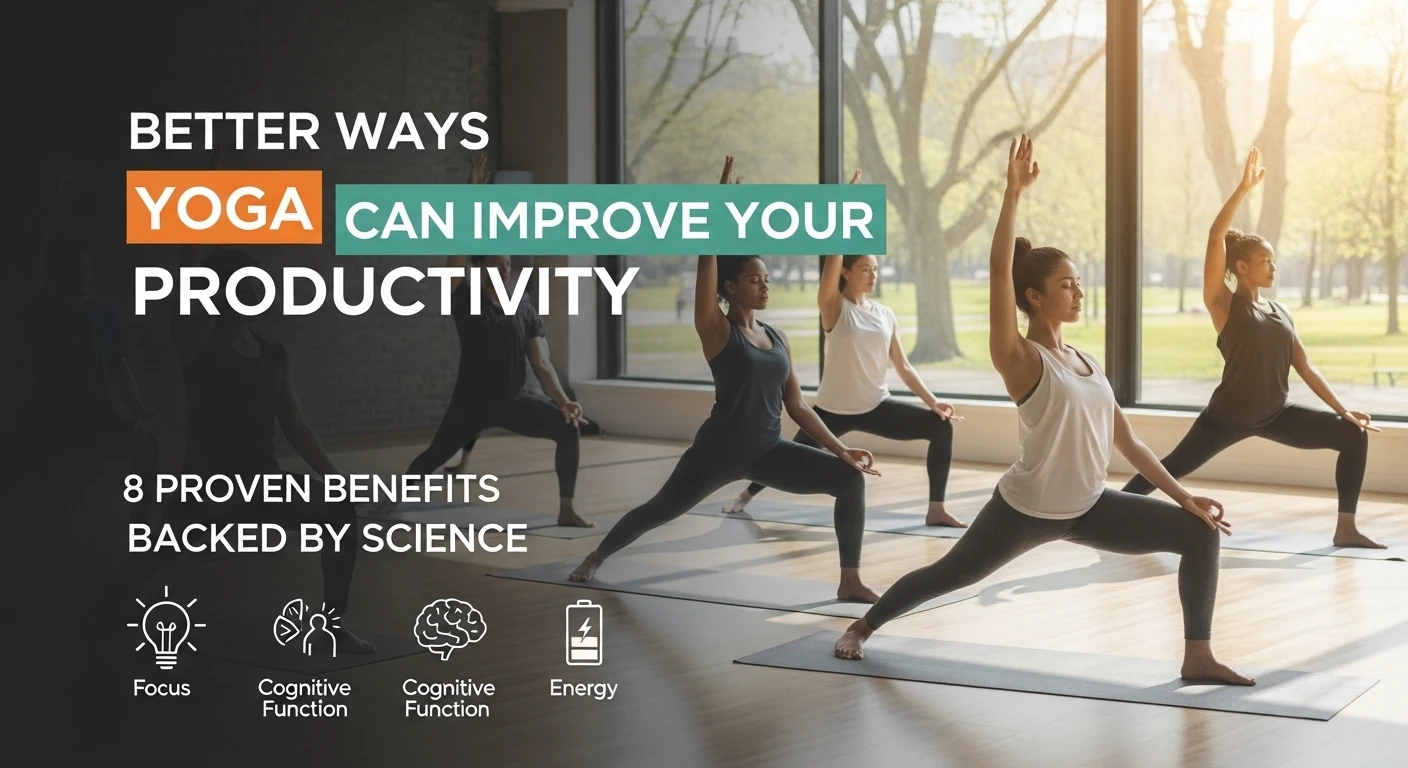
Most people, when they think about getting more done, think about systems. Time-blocking. Better task management. Fewer distractions. A cleaner inbox. And those things matter, more or less. But there’s a category of productivity lever that tends to get overlooked — the ones that operate at the level of the nervous system itself.
That’s basically where yoga lives. And it’s why better ways yoga can improve your productivity is less about stretching and more about how your brain functions under pressure, how quickly you recover between demands, and how much of your cognitive capacity is actually available to you at any given moment.
It sounds a little abstract until you experience it. Then it makes a lot of sense.
Better Ways Yoga Can Improve Your Productivity — The Real Picture
Better ways yoga can improve your productivity include reducing cortisol and mental fatigue, sharpening sustained attention, improving sleep quality, regulating breath and nervous system response, and building the mental clarity needed for deep work. Even 20–30 minutes of daily practice can meaningfully improve focus, energy, and cognitive resilience within a few weeks.
Yoga gets filed under wellness, or flexibility, or stress relief — and it does all of those things. But that framing undersells what’s actually happening when you practice consistently. The body-mind integration that yoga trains has direct consequences for how you think, how long you can concentrate, how you respond when things go sideways, and how well you recover when your cognitive reserves run low.
The Harvard Health Blog and various published neuroscience studies have documented yoga’s effects on the brain — including changes to the prefrontal cortex, reductions in the default mode network’s tendency to wander, and improvements in working memory. These aren’t small things when it comes to daily output.
Here’s the thing — productivity isn’t just about time. It’s about the quality of attention you bring to that time. And that’s where yoga, practiced consistently, starts to make a quiet but significant difference.
How Yoga Changes the Way Your Brain Focuses
Sustained focus — the ability to stay with a task without being pulled away every few minutes — is genuinely difficult for most people, and it’s getting harder. The environment is designed for distraction. But attention is also a trainable capacity, not a fixed trait.
Yoga trains attention in a fairly direct way. Every time you hold a pose while keeping your mind on your breath, or return your awareness to your body after noticing it has wandered, you’re practicing the fundamental skill of focus. It’s essentially meditation with a physical anchor — and that anchor makes it more accessible for people who find sitting meditation frustrating.
Over time, that practice transfers. The same mental habit of noticing distraction and gently returning to the task becomes more available in other contexts. A meeting. A complex document. A problem that requires sustained thinking. The reflexive pull toward your phone, or the next thing on the list, loses some of its grip.
That’s really what it comes down to — yoga doesn’t make you focused. It makes the act of refocusing easier and faster. And that’s actually the more valuable skill.
The Stress-Productivity Loop Yoga Quietly Interrupts
There’s a pattern that most productive people know intimately, even if they don’t always name it. Stress accumulates during a demanding stretch of work. That stress makes it harder to concentrate, harder to make decisions, harder to think creatively. The diminished output creates more stress. And so on.
It’s a self-reinforcing loop, and it’s one of the main reasons that simply working harder or longer rarely solves a productivity problem. You’re trying to increase output from a system that’s already under strain.
Better ways yoga can improve your productivity sit right at this loop. A consistent yoga practice — even a short one — acts as a circuit breaker. It brings the nervous system out of the sympathetic dominance that sustained stress creates, activates the parasympathetic response, and gives the brain a genuine recovery window.
This isn’t relaxation in the soft sense. It’s physiological reset. Cortisol drops. Inflammation markers reduce. The prefrontal cortex — responsible for planning, decision-making, and impulse control — comes back online more fully. You return to your work with more actual capacity, not just a slightly better mood.
Or at least, that’s how it tends to play out for people who make the practice consistent.
Better Energy Management Throughout the Day
One of the subtler but genuinely important ways yoga improves productivity is through energy — not in a vague metaphysical sense, but in the plain, practical sense of having more sustained mental and physical energy across the workday.
Most people experience a fairly predictable energy arc: reasonably alert in the morning, declining through the afternoon, sometimes rallying in the evening at the cost of sleep quality. That arc is partly biological, but it’s also shaped by how much tension the body is carrying, how well the breath is functioning, and how frequently the nervous system gets a genuine recovery signal.
Yoga addresses all three of those things. Physically, it releases chronic muscular tension — particularly in the shoulders, neck, hips, and lower back — that quietly drains energy by keeping the body in a low-grade state of alertness. That tension is often invisible until it’s gone, at which point the difference in how much effort everyday movement and sitting requires becomes noticeable.
The breath work embedded in yoga also tends to improve baseline oxygen delivery and carbon dioxide tolerance over time — which sounds technical but shows up practically as more sustained alertness, fewer afternoon energy crashes, and better cognitive stamina in the late parts of the day.
Why Your Breathing Patterns Matter More Than You Think
This one tends to surprise people. Breathing feels automatic — what could there possibly be to improve? But the way most people breathe under stress or during concentrated work is, in some respects, counterproductive. Shallow chest breathing, breath-holding, rapid irregular breathing — these are all common responses to cognitive load and anxiety, and they all feed back into the nervous system in ways that amplify stress and impair thinking.
Yoga systematically trains slower, deeper, more regulated breathing patterns. And that training doesn’t stay on the mat. With practice, the breath becomes a tool — something you can actually use in the middle of a difficult conversation, a stressful deadline, or a moment of decision fatigue to shift your physiological state relatively quickly.
The American Institute of Stress has noted that diaphragmatic breathing activates the vagus nerve and initiates a parasympathetic response within seconds — a real physiological shift, not just a psychological trick. For productivity, the implication is meaningful: you have more access to your own regulatory capacity than most people realize, and yoga is one of the most effective ways to develop it.
Better Ways Yoga Can Improve Your Productivity Through Sleep
Sleep is, basically, the foundation everything else is built on. You can optimize your workflow, your environment, your habits — and still hit a ceiling if you’re sleeping poorly. Because sleep is when the brain consolidates learning, clears metabolic waste, regulates emotion, and restores the cognitive resources depleted during the day.
Yoga improves sleep — this is fairly well documented. Regular practice is associated with faster sleep onset, reduced nighttime waking, and improved sleep quality in both healthy adults and people dealing with insomnia or anxiety-related sleep disruption.
The mechanisms are a few: lower cortisol levels in the evening (yoga shifts cortisol’s daily rhythm toward a healthier pattern), reduced physical tension that otherwise keeps the nervous system slightly activated through the night, and the relaxation response trained during practice that carries into the pre-sleep period.
Better sleep doesn’t just mean feeling less tired. It means sharper attention the following day, better working memory, more emotional regulation under pressure, and more creative problem-solving — all things that matter directly to how productive you actually are.
The Mental Clarity Effect — What Practitioners Actually Notice
There’s a quality of mind that consistent yoga practitioners often describe — and it’s a little hard to pin down but worth trying. It’s not exactly calm. It’s more like… clearness. A reduction in the background noise of competing thoughts, half-formed anxieties, and low-level rumination that occupies mental bandwidth without producing anything useful.
That mental noise is expensive in productivity terms. It eats working memory. It makes decisions harder. It slows processing because part of the cognitive system is always occupied with things that aren’t the current task.
Yoga — particularly when the practice includes some form of breath awareness or meditation — gradually reduces that noise. Not by suppressing thought, but by changing your relationship to it. Thoughts arise, you notice them without fully following them, and you return to the present. Practiced enough, that pattern creates more space between stimulus and response. More clarity in the moments that matter.
Well, actually, it’s worth being honest: this doesn’t happen overnight, and it’s not linear. Some weeks feel clearer than others. But over months of regular practice, most people who stick with it describe a meaningful shift in baseline mental noise — and in how much of their mind is actually available for the work in front of them.
Better Ways Yoga Can Improve Your Productivity at Work Specifically
Let’s bring this down to the level of the actual workday, because that’s where people want to see it land.
Decision fatigue — the degradation in decision quality that accumulates across a long day of choices — is partly a function of how depleted your prefrontal cortex gets. Regular yoga practice, by supporting better sleep and lower baseline stress, meaningfully reduces the speed at which decision fatigue sets in. Your judgment holds up longer.
Creative thinking benefits from what researchers call default mode network flexibility — the brain’s ability to shift between focused problem-solving and associative, open-ended thinking. Yoga and mindfulness practices have been shown to improve this flexibility, which shows up as better brainstorming, more novel connections between ideas, and fewer creative blocks.
Interpersonal effectiveness — the ability to listen well, respond thoughtfully rather than reactively, and manage difficult conversations without losing composure — is another area where the nervous system regulation yoga trains pays clear dividends. A lot of what looks like a productivity problem is actually a relationship or communication problem downstream.
Recovery between tasks also improves. The micro-recoveries between meetings, the brief transitions between types of work — these are where a lot of cognitive efficiency is either gained or lost. A person whose nervous system recovers quickly can context-switch more cleanly and bring more capacity to each successive demand. That’s something yoga builds, gradually, over time.
What Kind of Yoga, and How Often
For productivity specifically, certain styles tend to show up more consistently in the research and in practitioner accounts.
Hatha and gentle vinyasa — steady, breath-linked movement — are probably the most broadly accessible starting points and produce a reliable blend of physical release and nervous system regulation.
Yin yoga — longer-held passive poses targeting connective tissue and the parasympathetic nervous system — is particularly effective for people whose stress tends toward overactivation and tension. It’s slow, sometimes uncomfortably so, and that’s kind of the point.
Pranayama — dedicated breath practice, sometimes within a yoga class and sometimes as a standalone — is perhaps the most direct route to the focus and nervous-system regulation benefits relevant to productivity. Even ten minutes of structured breathing practice has measurable effects on attention and stress markers.
As for frequency — daily practice, even short, is more effective than longer sessions a few times a week. Twenty minutes every morning will do more for your focus and stress resilience over three months than ninety minutes twice a week. Consistency, again, is the real lever.
Building the Habit Without Overhauling Your Life
The practical challenge is making this real without creating a new source of pressure in a life that already has too many obligations.
A few things that tend to actually work:
Start with ten minutes. Not because ten minutes is the ideal dose — it isn’t — but because ten minutes is achievable on the worst mornings, and achievable beats perfect every time. The habit forms first; the duration expands later.
Morning tends to work better than evening for most people. Not because of any metabolic law, but because mornings are less subject to the entropy of the day. By evening, there are a hundred reasons not to roll out a mat.
Find one resource you actually like. A teacher whose voice doesn’t irritate you. A style that feels like something you’d choose rather than something you’re forcing yourself through. This matters more than most people think — you’ll skip the practice you dread far more readily than the one you find genuinely useful or interesting.
Don’t measure it by how flexible you’re getting. That’s not what you’re optimizing for. You’re optimizing for the quality of your mind and nervous system over time. Progress on that axis is subtler and slower to appear, but far more valuable.
If you want to go deeper on habits and mental performance, our articles on morning routines that actually work and how daily workouts help you cope better with stress cover complementary ground. And if you’re working with a healthcare professional on anxiety, burnout, or sleep issues, yoga pairs well with therapeutic support — it’s not a replacement, but it’s a meaningful complement.
FAQ: Yoga and Productivity
How long does it take for yoga to improve productivity?
Most people notice initial improvements in focus and stress tolerance within two to four weeks of consistent daily practice. Deeper changes — improved sleep, reduced baseline anxiety, more sustained mental clarity — typically emerge over one to three months.
Can beginners benefit from yoga for productivity, or do you need experience?
Beginners benefit immediately. The productivity-relevant effects — breath regulation, parasympathetic activation, present-moment attention — are accessible from the very first session. You don’t need to be flexible or experienced.
Is yoga better for productivity than meditation?
They’re complementary, not competing. Yoga is in many ways moving meditation, and the physical component makes it more accessible for people who find seated meditation frustrating. Both train similar underlying capacities. Combining them produces stronger results than either alone.
What time of day is yoga most effective for improving focus and energy?
Morning yoga tends to set a productive tone for the entire day by regulating cortisol rhythms and activating the parasympathetic nervous system before the demands of work begin. Short midday sessions can also serve as an effective cognitive reset between blocks of focused work.
How much yoga do I need to do each day to see productivity benefits?
Research and practical experience both suggest that even 15–20 minutes of daily practice produces meaningful benefits. The key variable is consistency — daily short sessions outperform infrequent longer ones for the nervous system regulation and habit formation that drive productivity gains.
There’s a kind of quiet irony in the fact that slowing down — actually stopping, breathing, moving with some intentionality — tends to make people more effective. Not less. The assumption that more hours and more effort will produce more output runs directly into the reality that the brain has limits, and those limits shift depending on how you maintain the system.
Yoga is, in some respects, maintenance. Unsexy, perhaps. But the kind that makes everything else work better.
Start where you are. Ten minutes. A mat on the floor. A video you don’t hate. That’s enough to begin.
For more on building a performance-supporting daily routine, explore our guides on sleep and cognitive performance and the best morning habits for focus and deep work.
Sources: