













QUICK ANSWER
How to be successful in bodybuilding and in life requires applying progressive overload principles, maintaining consistent nutrition discipline, and developing mental resilience through structured goal-setting. Success in both domains depends on treating challenges as training stimuli, measuring progress systematically, and adapting strategies based on feedback rather than emotion.
Introduction
How to be successful in bodybuilding and in life starts with understanding a truth most people miss: the gym is the most honest teacher you’ll ever meet. The barbell doesn’t care about your excuses, your job title, or how you feel today. It responds only to the work you put in, the consistency you maintain, and the intensity you bring.
Last year, I watched a guy walk into my gym carrying 40 extra pounds and a look that said he’d already failed before starting. Six months later, he’d dropped the weight, added 15 pounds of muscle, and landed a promotion at work he’d been chasing for three years. When I asked what changed, he said something that stuck with me: “I stopped negotiating with the weights. I showed up, did the work, and everything else started falling into line.”
The principles that build muscle transfer directly to career success, relationship quality, and personal growth. Progressive overload doesn’t just apply to your squat. It applies to your income, your skills, and your capacity to handle life’s heaviest loads. This is the blueprint for building both your physique and your future, backed by exercise science research from institutions like the National Strength and Conditioning Association.
Progressive Overload: The Foundation of All Growth
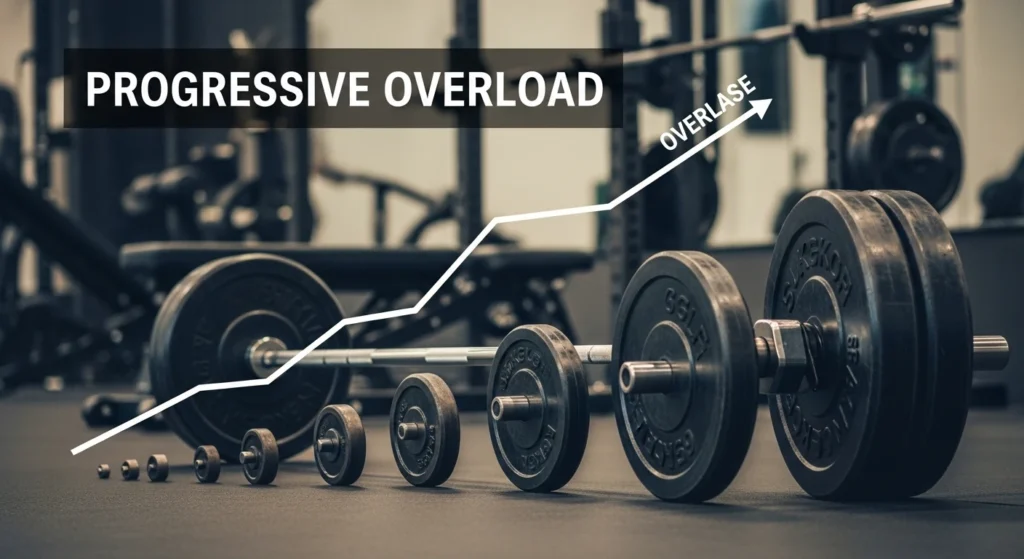
Progressive overload is the systematic increase of stress placed on the body during training, forcing muscular adaptation over time. In bodybuilding, this means gradually increasing weight, reps, or training volume. In life, it means deliberately expanding your capacity by taking on challenges slightly beyond your current comfort zone.
According to research from the American College of Sports Medicine, muscles grow when exposed to loads that exceed their current capacity, triggering protein synthesis and structural adaptation. The same mechanism drives skill acquisition and mental resilience.
Here’s how progressive overload works in both domains:
- Bodybuilding: Add 5 pounds to compound lifts weekly, increase volume by 10% monthly, or reduce rest periods while maintaining intensity
- Life: Take on projects 20% more complex than your current role, have difficult conversations you’ve been avoiding, or commit to learning one new high-value skill per quarter
- Recovery Integration: Schedule deload weeks every 4-6 weeks in training, and build recovery periods into work schedules to prevent burnout
- Measurement Systems: Track lifts in a training log, track professional wins in a career journal, review both monthly
- Adaptation Cycles: Growth happens during recovery, whether you’re building muscle or building a business
The biological reason this works comes down to homeostasis and adaptation. Your body maintains equilibrium until an external stressor forces it to adapt. When you lift heavy, muscle fibers sustain micro-tears. Your body repairs them stronger. When you tackle a difficult project at work, your brain builds new neural pathways.
A guy I trained with spent two years benching 185 for sets of 10. Same weight, same reps, same body. He wondered why nothing changed. We added 10 pounds every two weeks, and within six months he hit 275. His career was the same story. Once he started asking for stretch assignments, his income jumped 40% in 18 months.
The Science of Muscle and Momentum
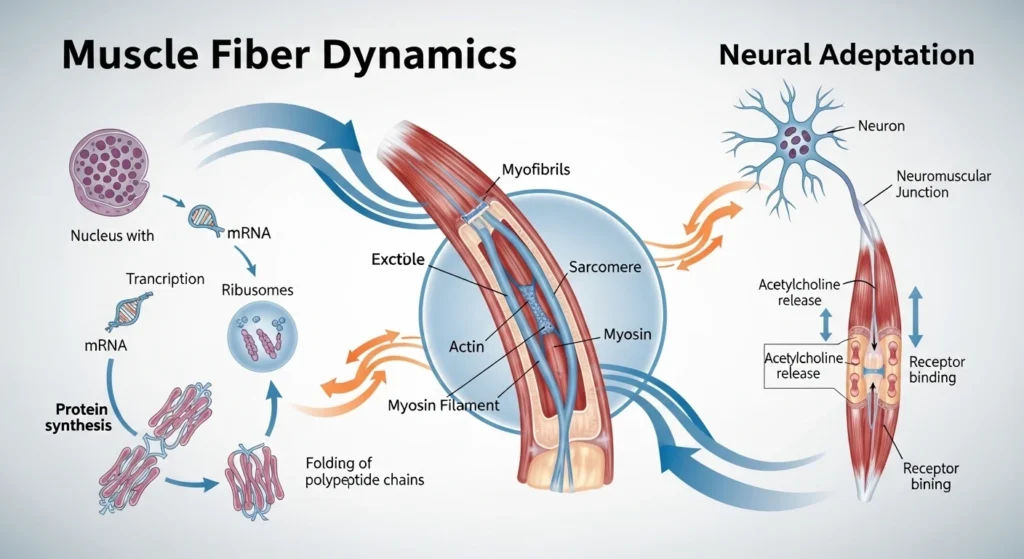
Building muscle and building momentum operate on parallel biological and psychological systems. Muscle protein synthesis (MPS) remains elevated for 24-48 hours after training. Research from the Journal of Applied Physiology shows that consuming 20-40g of protein post-workout maximizes this window.
But here’s the insight nobody connects: momentum in life works the same way. One strong action creates an elevated “readiness state” where follow-up actions become easier. Psychologists call this behavioral momentum.
Here’s how the science translates to practical application:
- Mechanical Tension: Lifting heavy creates tension in muscle fibers, the primary driver of hypertrophy. Taking on high-stakes projects creates psychological tension that drives skill development
- Metabolic Stress: Training to near-failure triggers hormonal responses supporting growth. Working under pressure builds stress tolerance
- Neural Efficiency: Your nervous system becomes more efficient at recruiting muscle fibers with consistent training. Your brain becomes more efficient at processing complexity with consistent mental challenges
- Recovery Supercompensation: Your body overcompensates during recovery, becoming stronger than baseline. Your mind does the same after processing difficult experiences
I trained a software engineer who couldn’t deadlift 225 and couldn’t negotiate his salary. We spent three months building his deadlift to 405 through systematic progressive overload. Then we applied the exact same framework to his career: identified his value, practiced difficult conversations, systematically increased his asks. He went from $85K to $135K in one negotiation. Same system. Different load.
The mechanism that builds your chest also builds your career. It’s called adaptive response, and it’s hardwired into your biology.

Choosing Your Training Strategy: When to Push, When to Adapt
Not all training strategies work for all goals. Your training approach should match your current objective.
Use Hypertrophy Training (Muscle Building) When:
- Your goal is maximizing muscle size and aesthetic development
- You’re in a caloric surplus or maintenance phase
- You can commit to 4-6 training sessions per week with adequate recovery
- Your form and movement patterns are solid
Use Strength Training When:
- Your goal is maximizing force production and lifting capacity
- You need to build a foundation before returning to hypertrophy work
- You want to improve neurological efficiency and movement confidence
Use Career Acceleration Strategies When:
- You’ve mastered your current role and need new challenges
- Market conditions favor your industry and opportunities are abundant
- Your skills are in demand and you can leverage competitive offers
Use Skill Development and Learning When:
- Your industry is shifting and your current expertise is becoming commoditized
- You see a clear gap between your capabilities and your next-level goals
- You need to differentiate yourself in a crowded competitive landscape
I spent three years chasing muscle growth while running a caloric deficit and sleeping five hours a night. My lifts stagnated. Once I committed to a proper 16-week hypertrophy phase (surplus calories, 7-8 hours sleep, 4 focused training days), I gained 18 pounds of muscle. Same effort, different strategy, completely different results.
The same thing happened in my business. I spent two years trying to scale through volume, taking every client. Revenue stayed flat. Then I switched strategies: fewer clients, higher prices, deeper value delivery. Revenue doubled, stress halved. Strategy matters more than effort when the strategy matches the goal.

The Mindset That Separates Winners from Quitters
Successful bodybuilders and successful people share one psychological trait: they interpret setbacks as data, not defeats. When a lifter misses a rep, they don’t question their identity. They adjust the weight, refine their form, or improve their recovery.
I’ve trained with guys who lifted heavier than me, ate cleaner than me, and had better genetics than me. Most of them quit within two years. Not because they lacked ability. Because they lacked the mental framework to process plateaus and bad training days.
Reframe Resistance as Feedback, Not Rejection
Every time you encounter resistance, you’re receiving feedback about your current capacity. When the weight won’t move, your body is telling you something about your programming or recovery. When a project stalls, reality is showing you where your skills need adjustment. Most people take resistance personally and quit. Winners take resistance analytically and adjust variables until they find the path forward.
Build Identity Around Process, Not Outcomes
The bodybuilder who defines success as “hitting 405 on deadlift” is fragile. If injury prevents that number, their identity collapses. The bodybuilder who defines success as “someone who shows up and improves consistently” is antifragile. Their identity strengthens regardless of external results because it’s built on what they control: behavior and effort. If your identity is built on process rather than outcomes, you become unbreakable.
Image Placeholder 6: Suggested before “When Strategies Fail” H2
Image Prompt: “Realistic scene showing an exhausted athlete sitting in a gym, contemplative expression, scattered weights around, honest portrayal of struggle and setback, moody lighting, authentic documentary style”
When Training and Life Strategies Fail
Every system breaks down eventually. The question isn’t whether you’ll hit a wall. It’s whether you’ll recognize it and adapt.
Training and progress stall when:
- You’ve been running the same program for 12+ weeks without variation. Solution: Change rep ranges, exercise selection, or intensity techniques every 8-12 weeks
- Your recovery capacity can’t match your training volume. Solution: Program a deload week (50-60% volume), improve sleep quality
- Your nutrition doesn’t support your training demands. Solution: Track intake for two weeks, compare against evidence-based macronutrient targets, adjust accordingly
- You’re chasing too many goals simultaneously. Solution: Prioritize one primary goal per 12-16 week training block
Life and career strategies fail when:
- You’re optimizing for someone else’s definition of success. Solution: Audit your goals against your actual values
- You’ve mistaken activity for productivity. Solution: Time-audit your week, eliminate low-value tasks
- Your environment actively works against your goals. Solution: Change your environment or change your goals
- You’re operating in a skillset deficit you refuse to acknowledge. Solution: Honest self-assessment, targeted skill development
A friend trained six days a week for two years with zero progress. I looked at his program and his life: he was sleeping four hours a night, eating one meal a day, running the same workout split from 2019. We cut training to four days, fixed his sleep and nutrition, changed his program every eight weeks. He gained 15 pounds of muscle in six months.
Failure isn’t a character flaw. It’s a feedback signal.

My Personal Protocol: Building Systems That Last
I don’t rely on motivation. I rely on systems. Motivation is a feeling. Systems are a structure. Feelings fluctuate. Structure persists.
Monday Morning Protocol:
Every Monday at 6 AM, I review the previous week’s performance: lifts completed, body weight, energy ratings, work accomplishments, stress level. I compare current data against my 12-week targets. If I’m on track, I continue. If I’m stalling, I adjust one variable. This weekly review takes 15 minutes and prevents months of spinning my wheels.
How to build your own review system:
- Choose a consistent time each week when you’re mentally fresh
- Track metrics that matter: body weight, key lifts, recovery quality, project completion, skill development
- Use a 1-10 subjective rating scale for things you can’t measure objectively
- When performance declines, ask diagnostic questions: What changed? Am I recovering adequately?
- Make one clear adjustment, then give it 2-4 weeks to show results before changing anything else
- Celebrate wins, no matter how small
The system works because it creates accountability and forces me to confront reality. I know within two weeks if a new protocol is working. Systems don’t require discipline. They create discipline by making the path forward obvious.

Final Thoughts
How to be successful in bodybuilding and in life isn’t complicated. It’s just hard. The principles are simple: progressive overload, consistent execution, intelligent recovery, systematic tracking, and adaptive strategy.
Here’s what nobody wants to hear: you don’t need more information. You need more implementation. You don’t need a better program. You need to follow your current program long enough to see results.
The gym teaches you this lesson every session. The weight doesn’t move because you thought about it. It moves because you applied force, consistently, over time. Your career doesn’t advance because you want it to. It advances because you developed skills and delivered value over months of focused effort.
If you take one thing from this, take this: start. Start with one training session this week. Start with one difficult conversation at work. Start tracking one metric that matters. Start small, but start decisively, and let progressive overload transform you into someone capable of handling loads that would’ve crushed the person you were when you started.
The barbell is waiting. So is everything else.
FAQ
What is the most important factor for bodybuilding success?
Progressive overload combined with adequate recovery is the most important factor. You must consistently increase training stimulus while providing sufficient nutrition, sleep, and rest periods for adaptation. According to the National Strength and Conditioning Association, muscle growth requires both mechanical tension from training and sufficient recovery resources.
How long does it take to see results from bodybuilding?
Noticeable muscle growth typically appears within 8-12 weeks of consistent training for beginners. Strength gains appear faster, often within 2-4 weeks, due to neurological adaptations. Long-term transformation requires 6-12 months of dedicated effort.
Can I build muscle and lose fat at the same time?
Simultaneous muscle gain and fat loss is possible but limited, primarily for beginners or detrained individuals. For most trained individuals, alternating between focused muscle-building phases (slight surplus) and fat-loss phases (moderate deficit) produces better results.
How do bodybuilding principles apply to career success?
Bodybuilding principles transfer through progressive overload (increasingly challenging projects), systematic tracking (measuring metrics), strategic recovery (preventing burnout), and adaptive programming (adjusting strategies based on feedback). The same discipline that builds muscle also builds skills and professional capital.
What should I do when I hit a training plateau?
Assess recovery quality first (sleep, stress, nutrition), then evaluate your program for needed variation. Common solutions include deload weeks, changing rep ranges, adjusting volume, or improving protein intake. Most plateaus result from inadequate recovery or lack of program variation.
How important is nutrition compared to training?
Nutrition and training are equally critical, each contributing approximately 50% to body composition results. Optimal results require proper macronutrient intake (especially 0.8-1g protein per pound bodyweight), appropriate caloric balance, and nutrient timing around training.
What’s the biggest mistake people make when trying to improve?
The biggest mistake is inconsistency disguised as experimentation. People change programs every few weeks and never commit long enough to see results. Sustainable transformation requires following a sound strategy for 8-16 weeks minimum before evaluating effectiveness.
How do I stay motivated when progress slows down?
Replace motivation with systems and identity. Build identity as “someone who trains consistently” rather than “someone trying to get in shape.” Identity-based behavior persists when feelings fluctuate. Track small wins and process metrics rather than only outcome metrics.