














How to Reset Your Mind in 5 Minutes: Science-Backed Techniques to Feel Calm Fast
Your mind is racing. Deadlines are stacking up. That voice in your head won’t shut up about everything you need to do, everything that could go wrong, everything you forgot to handle yesterday. Sound familiar?
Most people think they need a vacation or a meditation retreat to understand how to reset their mind in 5 minutes. Here’s what research actually shows: you can interrupt stress cycles and recalibrate your nervous system in about five minutes if you know the right techniques. I’m talking about specific, neuroscience-backed methods that actually shift your brain chemistry fast, not generic “just breathe” advice.
This article walks you through seven proven techniques for learning how to reset your mind in 5 minutes when stress hits. You’ll learn which method works for different types of mental overwhelm, why these techniques work at the biological level, and how to build your own personal reset protocol. These aren’t feel-good theories. They’re practical tools backed by research from Stanford’s Stress Lab and used by everyone from trauma therapists to Navy SEALs.

Why Your Brain Gets Stuck: The Biology of Stress Patterns
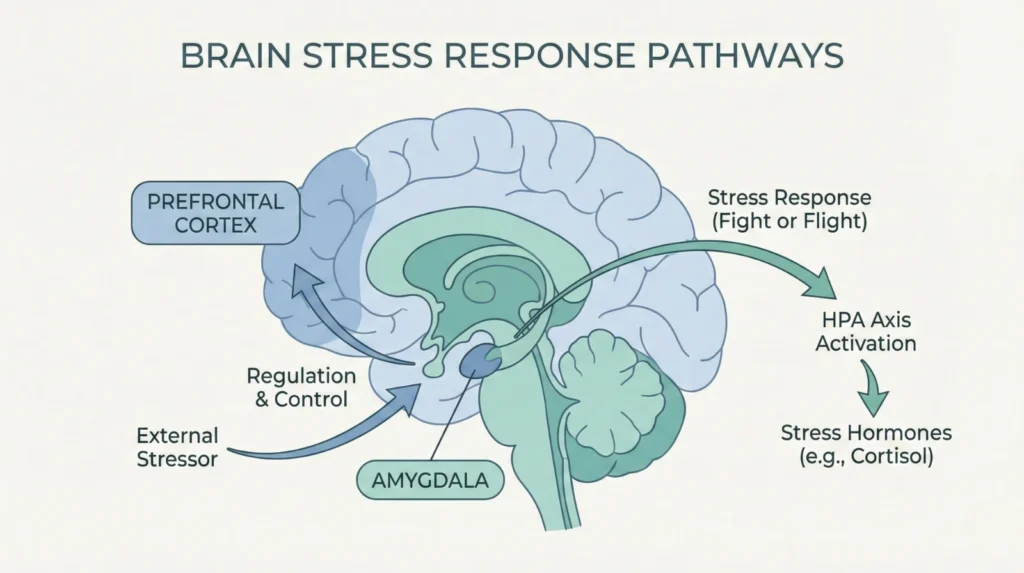
Your brain gets stuck in stress mode when your amygdala hijacks control from your prefrontal cortex during perceived threats. This biological response can be interrupted quickly using specific techniques that activate your parasympathetic nervous system, shifting you from fight-or-flight to rest-and-digest in as little as 90 seconds.
Let me explain something most stress-management articles skip: your brain operates in patterns. When you’re stressed, your prefrontal cortex (the part responsible for rational thinking) essentially goes offline while your amygdala hijacks control. This isn’t a weakness. It’s biology.
The good news? These neural patterns can be interrupted quickly. Research from Stanford’s Stress Lab shows that brief interventions, sometimes as short as 90 seconds, can shift you from sympathetic (fight-or-flight) to parasympathetic (rest-and-digest) nervous system dominance. You’re not trying to eliminate stress. You’re hitting a neurological reset button.
Last month, a colleague told me she tried every mindfulness app available, and nothing worked. Turns out she was expecting these tools to make stress disappear permanently. That’s not how to reset your mind in 5 minutes; it actually works. What works is recognizing when your nervous system is overloaded and using precise techniques to recalibrate in the moment. That’s the difference between trying to force relaxation and strategically resetting your mental state.
Key biological mechanisms at play:
- Amygdala hijack: Your emotional center overrides logical thinking during stress
- Prefrontal cortex shutdown: Rational processing goes offline when threat responses activate
- Sympathetic dominance: Your fight-or-flight system stays activated even after threats pass
- Vagus nerve activation: Specific interventions can trigger your body’s natural calming mechanisms
- Pattern disruption: Breaking thought loops requires engaging different neural pathways
Understanding this biology matters. When you know what’s happening in your brain, you can choose the right intervention instead of hoping generic relaxation works.
The Physiological Sigh: Your Emergency Brake for Anxiety
Here’s something most people don’t know: you naturally do a physiological sigh after crying or during moments of high stress. Your body already knows this works. Neuroscientist Andrew Huberman’s lab discovered that doing this consciously is one of the fastest ways to reduce anxiety and master how to reset your mind in 5 minutes.
How it works:
- Take a deep breath in through your nose
- Before exhaling, take a second shorter inhale to expand your lungs fully
- Exhale slowly and completely through your mouth
- Repeat two to three times
What makes this different from regular deep breathing? That second mini-inhale fully inflates the alveoli in your lungs, which triggers your vagus nerve and immediately reduces your heart rate. You’re not just breathing deeply. You’re activating a specific biological mechanism that calms your nervous system.
I tested this before a high-stakes presentation last year. Three physiological sighs, maybe ninety seconds total. My heart rate dropped from anxious-racing to focused-alert. Not calm exactly, but functional. That’s what you’re looking for when figuring out how to reset your mind in 5 minutes: not zen mode, but bringing your nervous system back to baseline so you can think clearly.
The research backs this up. Studies from Stanford show the physiological sigh produces more rapid stress reduction than any other breathing technique, including extended exhale breathing and box breathing. The key is that double inhale. It’s not optional. That’s what makes this technique work.
The 5-4-3-2-1 Grounding Method: When Your Thoughts Won’t Stop Spiraling
This technique comes from trauma therapy, but it works for everyday mental overload. When your mind is stuck in a worry loop, replaying conversations, catastrophizing about the future, cycling through the same anxious thoughts, you need to interrupt that pattern by forcing your brain to focus on something concrete right now.
Here’s the protocol for how to reset your mind in 5 minutes using grounding:
- Name five things you can see right now: Be specific (the blue pen on your desk, the crack in the wall, your coffee mug)
- Name four things you can physically feel: Your feet on the floor, the chair supporting your back, the weight of your phone in your hand
- Name three things you can hear: Traffic outside, the hum of your computer, someone talking in another room
- Name two things you can smell: Or two smells you like
- Name one thing you can taste, Or something you’re grateful for
Why this works: rumination happens in your brain’s default mode network. By engaging your sensory processing systems, you’re literally pulling neural activity away from the worry circuits. You’re not suppressing the anxious thoughts. You’re shifting your brain’s focus to immediate sensory input, which activates the present-moment processing centers in your parietal cortex.
A friend who struggles with panic attacks uses this in crowded spaces. She told me it sounds too simple to work, but when your heart is pounding, and you feel like you’re losing control, forcing yourself to identify specific sensory details creates just enough cognitive distance to stop the panic spiral. Takes about two minutes. Doesn’t make the stress disappear, but breaks the escalation pattern.
This is one of the most reliable methods for how to reset your mind in 5 minutes when rumination takes over. The specificity matters. Don’t just think “I see a pen.” Actually, look at the pen. Notice its color, shape, and where it’s sitting. That level of detail is what pulls your attention into the present moment and out of the worry loop.
Cold Water Face Immersion: The Instant Nervous System Override
This one surprises people because it feels too physical to be about a mental reset. But your nervous system doesn’t care about the distinction between mental and physical. It responds to physiological signals, which is exactly what makes this one of the most powerful techniques for how to reset your mind in 5 minutes.
When you submerge your face in cold water (or hold a bag of ice against your face), you trigger something called the mammalian dive reflex. Your heart rate drops immediately. We’re talking within seconds. Blood flow redirects from your extremities to your core organs. Your entire autonomic nervous system shifts gears.
How to do it quickly:
- Fill a bowl with ice water or grab an ice pack from your freezer
- Hold your breath and submerge your face for fifteen to thirty seconds (or press the ice pack against your cheeks and forehead)
- Come up, breathe normally, repeat if needed
This isn’t comfortable. That’s the point. The cold shock interrupts whatever stress response is running in the background. Dialectical Behavior Therapy teaches this as a crisis intervention tool, but you don’t need to be in crisis to use it. Sometimes you just need to hit the emergency brake on escalating anxiety or anger.
I keep ice packs in my office freezer specifically for this. When I feel that pre-overwhelm tension building (jaw clenched, shoulders tight, thoughts starting to race), thirty seconds with ice against my face brings everything down several notches. It’s not subtle or elegant, but it’s effective when you need to know how to reset your mind in 5 minutes during peak stress.
The physiological response is involuntary. You can’t think your way out of triggering the dive reflex. The cold water does it automatically. That’s what makes this technique reliable, even when other methods aren’t cutting through the intensity.

Box Breathing: Pattern Interruption Through Rhythm
Navy SEALs use this technique before high-stress operations. Not because it makes them relaxed, but because it gives them control over their physiological state when everything feels chaotic. Box breathing creates a rhythm that regulates your autonomic nervous system by balancing oxygen and carbon dioxide levels in your blood. It’s a reliable method for how to reset your mind in 5 minutes when you need controlled regulation.
The pattern:
- Inhale through your nose for four counts
- Hold your breath for four counts
- Exhale through your mouth for four counts
- Hold empty for four counts
- Repeat for three to five minutes
What’s happening physiologically: controlled breathing at this rhythm activates your parasympathetic nervous system while preventing hyperventilation. The holds between breaths prevent the rapid breathing that fuels anxiety. You’re essentially giving your nervous system very clear instructions through breath rhythm.
This works best when you need to transition between high-pressure situations. Before a difficult conversation. After receiving bad news. Right before you need to make an important decision, the rhythm forces your attention to something concrete while your nervous system recalibrates.
Three minutes of box breathing won’t solve your problems, but it might give you enough mental clarity to think through them rationally instead of reactively. That’s the practical value of understanding how to reset your mind in 5 minutes: you’re not eliminating challenges, you’re making sure your nervous system isn’t sabotaging your ability to handle them.
According to research on controlled breathing techniques, the four-count pattern specifically helps balance your autonomic nervous system more effectively than irregular breathing patterns. The holds matter as much as the breaths themselves.
Progressive Muscle Relaxation: Release What You’re Holding
Most people carry stress physically without realizing it. Tight shoulders. Clenched jaw. Fists balled up. Your muscles hold tension long after the stressful moment passes, which keeps your nervous system in alert mode. Progressive muscle relaxation teaches your body the difference between tension and release, making it essential for how to reset your mind in 5 minutes when physical tension dominates.
Quick version for mental reset:
- Start with your fists: clench them as tight as possible for five seconds, then release completely
- Move to your arms: tense your biceps and forearms, hold, release
- Shrug your shoulders up to your ears, hold, drop them
- Squeeze your face tight (yes, make an exaggerated grimace), then relax
- Clench your jaw, hold, release
The contrast is what matters. By deliberately tensing and then releasing, you’re teaching your nervous system what relaxation actually feels like. Most people think they’re relaxed when they’re actually holding baseline tension. This technique makes the difference obvious.
I notice this most in my shoulders and jaw. When I’m stressed, my shoulders creep up toward my ears and stay there. Consciously tensing them even more and then letting them drop creates an immediate physical release that my brain interprets as safety. It takes maybe ninety seconds to cycle through the major muscle groups, but the tension release signals to your amygdala that the threat is over.
This is particularly effective for people who hold stress physically. If you notice neck pain, shoulder tension, or headaches when you’re stressed, progressive muscle relaxation is probably your most effective tool for how to reset your mind in 5 minutes. Your body is telling you where the stress lives. This technique gives you a way to release it.
Bilateral Stimulation: Calm Through Movement Pattern
This comes from EMDR therapy (Eye Movement Desensitization and Reprocessing), but you don’t need trauma to benefit from it. Bilateral stimulation (alternating left-right physical input) helps process emotional distress and calm racing thoughts. The mechanism isn’t fully understood, but research suggests it engages both hemispheres of your brain simultaneously, which appears to reduce emotional intensity. It’s an often-overlooked method for how to reset your mind in 5 minutes during emotional activation.
Simple ways to use this:
- Cross-body tapping: Tap your left shoulder with your right hand, then your right shoulder with your left hand, alternating rhythmically for two minutes
- Walking with deliberate awareness: Focus on alternating steps, left foot, right foot, concentrating on the rhythm
- Butterfly hug: Cross your arms over your chest and alternately tap your shoulders
The rhythm matters more than the specific movement. You’re creating a predictable, alternating pattern that your nervous system can synchronize with. This works particularly well when you’re emotionally activated (angry, anxious, or feeling emotionally flooded). The bilateral movement helps discharge the emotional intensity without suppressing it.
When something really upsets me (a conflict, bad news, feeling attacked), I’ll go for a walk and focus intensely on the left-right rhythm of my steps. Something about that alternating movement pattern pulls me out of the emotional spiral. After about five minutes, I can think about the situation more clearly instead of just reacting from the emotional center of my brain.
According to research on EMDR mechanisms, the bilateral stimulation appears to help the brain process distressing information more effectively. While the full mechanism is still being studied, the practical results are consistent enough that it’s worth including in your toolkit for how to reset your mind in 5 minutes.
What Makes These Techniques Actually Work (and Why Others Don’t)
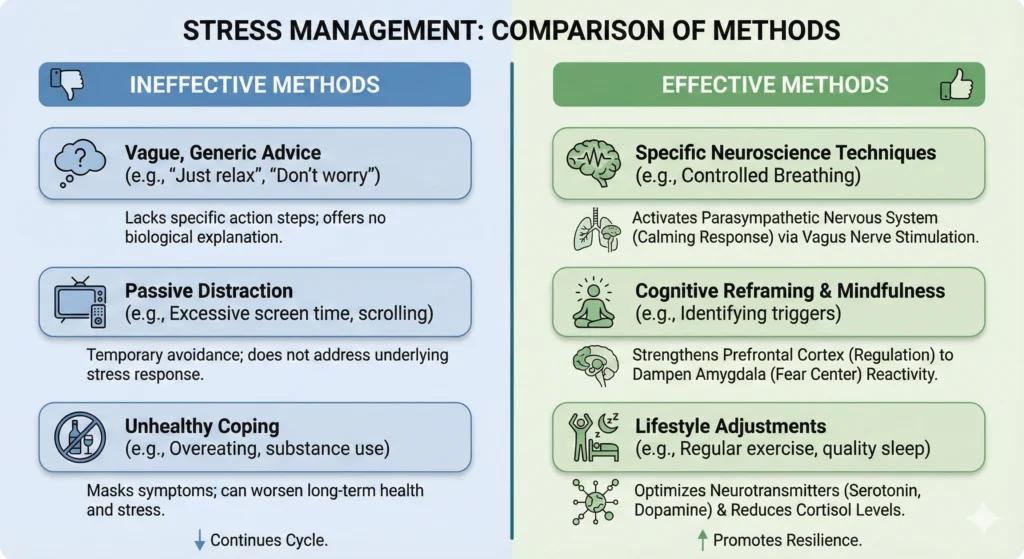
Let’s be honest about why generic stress advice fails. Most recommendations sound good but lack specificity. “Practice mindfulness.” Okay, but how exactly? “Just relax.” Can’t force relaxation, that’s not how the nervous system works. “Think positive thoughts.” Doesn’t address the physiological stress response at all.
The techniques I’ve described work because they target specific biological mechanisms. They’re not about positive thinking or willpower. They’re about giving your nervous system precise inputs that trigger the parasympathetic response. You’re working with your biology, not fighting against it.
Here’s what differentiates effective techniques for how to reset your mind in 5 minutes from feel-good advice:
- They activate the vagus nerve or other parasympathetic pathways
- They interrupt the default mode network (where rumination happens)
- They create immediate physiological changes you can feel
- They’re specific enough that you know if you’re doing them correctly
- They work within minutes, not weeks of practice
You don’t need to become an expert meditator or attend a wellness retreat. You need practical tools that work fast when you’re actually stressed. That’s the difference between stress management theory and techniques you’ll actually use when your nervous system is overloaded.
The research backing these techniques comes from fields as diverse as neuroscience, trauma therapy, military training, and performance psychology. They’ve been tested in real-world, high-stress situations. They’re not theoretical. They’re proven interventions that work when you need them most.
How to Choose the Right Technique in the Moment
Different techniques work for different types of mental overwhelm. You don’t need to try all of them every time. Match the tool to what you’re experiencing right now. Knowing how to reset your mind in 5 minutes means knowing which technique fits your current state.
Use physiological sighs when:
- Your anxiety is ramping up quickly
- You feel physically agitated or restless
- Your breathing is already shallow or rapid
- You need something fast and discreet, you can do anywhere
Use 5-4-3-2-1 grounding when:
- Your thoughts are spiraling and won’t stop
- You’re catastrophizing about the future or ruminating about the past
- You feel disconnected from your immediate environment
- You need to interrupt a worry loop that keeps cycling
Use cold water face immersion when:
- You’re experiencing intense emotional activation
- You feel rage building or panic starting
- Nothing else is cutting through the intensity
- You need an immediate physiological intervention that’s impossible to ignore
Use box breathing when:
- You need to transition between tasks or contexts
- You’re about to enter a high-pressure situation
- You have a few minutes of privacy
- You need steady, controlled regulation rather than emergency intervention
Use progressive muscle relaxation when:
- You notice physical tension you can’t seem to release
- Your shoulders are up around your ears
- Your jaw is clenched
- You’re holding stress in your body even when your mind feels relatively calm
Use bilateral stimulation when:
- You’re emotionally flooded after conflict or bad news
- You feel stuck in an emotional reaction
- Thinking about the situation keeps making you more upset
- You need to process emotional intensity rather than just calm down
Over time, you’ll develop intuition for which technique your nervous system needs in the moment. Think of these as tools in a kit. Not every problem needs the same tool, and part of getting good at how to reset your mind in 5 minutes is learning to accurately assess your current state.
The Real Goal: Building Mental Flexibility, Not Permanent Calm
Here’s where most people get this wrong. They think the goal is to never feel stressed, never get anxious, and achieve some permanent state of zen. That’s not realistic, and it’s not even desirable. Stress responses exist for good reasons. They mobilize energy, sharpen focus, and prepare you for challenges.
The actual goal is flexibility. Can you shift your state when you need to? When your nervous system gets stuck in high alert, can you bring it back down? When you’re ruminating unproductively, can you interrupt that pattern? That’s what these techniques give you: not permanent calm, but the ability to regulate your state in the moment.
Think of it like having a thermostat for your nervous system. Sometimes you need activation (before a presentation, during a deadline, in situations that require intense focus). Sometimes you need to calm down (after conflict, before sleep, when anxiety is interfering with clear thinking). These techniques let you adjust the dial deliberately instead of being at the mercy of whatever your nervous system happens to be doing.
I use different techniques multiple times a day. Before difficult conversations. After receiving challenging feedback. When transitioning from work mode to personal time. When I wake up at three in the morning with racing thoughts. They don’t make stress disappear, but they give me agency over my mental state.
That’s the difference between feeling controlled by your nervous system and having tools to work with it. Understanding how to reset your mind in 5 minutes isn’t about achieving perfect calm. It’s about having reliable methods to shift your state when it’s interfering with your ability to function effectively.
The research on stress resilience supports this approach. According to studies on psychological flexibility, the ability to shift between states is more predictive of well-being than baseline stress levels. It’s not about how stressed you get. It’s about how quickly you can regulate when stress hits.
What to Do When Nothing Seems to Work
Sometimes these techniques won’t work. Not because they’re ineffective, but because you’re trying to use them in the wrong way or at the wrong time.
Common reasons these techniques fail:
- Unrealistic expectations: You’re expecting them to eliminate stress completely instead of just bringing you back to baseline. That’s not how nervous system regulation works.
- Forcing relaxation: You’re trying to force calm instead of allowing your body to shift naturally. The more you try to force it, the more activation you create.
- Wrong intensity level: You’re so activated that you need a stronger intervention first (like cold water immersion before attempting something subtle like box breathing).
- Chronic vs. acute stress: You’re dealing with chronic stress that needs more than quick interventions. These techniques work for acute stress and mental overwhelm, not for systemic burnout or ongoing trauma.
- Insufficient practice: You’re not giving them enough time to work. Doing one physiological sigh and expecting instant transformation isn’t realistic. These need two to five minutes of consistent practice to shift your state.
If you’ve tried multiple techniques and nothing is making a difference, that might be a signal that you need more support than self-regulation tools can provide. Persistent anxiety, depression, or inability to regulate your nervous system, even with these techniques, might indicate it’s time to talk to a mental health professional. These tools are powerful, but they’re not substitutes for therapy when you actually need it.
Be careful here. Sometimes the difficulty isn’t that the technique doesn’t work. It’s that you’re judging whether it worked based on unrealistic expectations. If you use box breathing and your heart rate drops and your thoughts clear slightly, but you still feel some baseline stress, that’s success. You’re not trying to achieve enlightenment when learning how to reset your mind in 5 minutes. You’re just trying to function better than you were before.
Building Your Personal Reset Protocol
The most effective approach is having a go-to sequence you can run through when you feel yourself losing mental equilibrium. Not trying to remember all six techniques in the moment, but having a personal protocol you’ve practiced enough that it’s automatic.
Here’s mine:
First, I notice I’m escalating. That awareness alone sometimes interrupts the pattern. If noticing isn’t enough, I do three physiological sighs. Takes ninety seconds. If that brings me down enough, I’m done.
If I’m still activated, I’ll use the 5-4-3-2-1 grounding to interrupt whatever thought spiral is happening. If I’m really activated (like genuinely panicking or enraged), cold water to the face. That’s a non-negotiable emergency intervention.
Your protocol will look different. Maybe you respond better to movement than breathing. Maybe you need progressive muscle relaxation before anything else works. The key is experimenting when you’re not in crisis so you know what actually works for your nervous system.
To build your protocol for how to reset your mind in 5 minutes:
- Try each technique when you’re relatively calm, so you understand how it feels
- Notice which ones create the clearest shift in your state
- Create a hierarchy: what’s your first intervention, what’s your backup, what’s your emergency option
- Practice your sequence regularly so it becomes automatic
- Adjust based on what actually works for you, not what sounds good in theory
The goal is to have something you can reach for automatically when you notice yourself dysregulating. Not something you need to consciously remember or deliberate about in the moment. A practiced response that kicks in when you recognize the early signs of mental overwhelm.
This is what separates people who know how to reset their mind in 5 minutes theoretically from people who can actually do it when they need it. The difference is practice and personalization. You’re building a toolkit that works for your specific nervous system, your specific stress patterns, your specific life circumstances.
What This Means for You
You don’t need hours of meditation practice or a complete lifestyle overhaul to manage stress effectively. You need specific, evidence-based techniques that work with your nervous system’s biology. The techniques I’ve outlined here (physiological sighs, grounding, cold water, box breathing, progressive muscle relaxation, bilateral stimulation) all target precise neurobiological mechanisms that regulate your stress response.
This isn’t about achieving some Instagram-worthy zen lifestyle. It’s about having functional tools that let you reset when you need to, so your nervous system doesn’t stay stuck in high alert mode. That’s the actual goal of understanding how to reset your mind in 5 minutes: not permanent calm, but the flexibility to shift your state deliberately when it’s interfering with your ability to think, work, or interact effectively.
Start with one technique. Try it a few times when you’re moderately stressed (not in full crisis, but when you notice your nervous system ramping up). Notice what happens. Does your heart rate drop? Do your thoughts clear slightly? Can you breathe more easily? Those are the signals that a technique is working for you.
If you’re dealing with this kind of mental overwhelm regularly, don’t wait until you’re completely dysregulated to use these tools. Build them into your routine. Use them preventively when you know you’re heading into stressful situations. Think of it like stretching before exercise. You’re preparing your nervous system to handle intensity rather than trying to fix the damage afterward.
Internal link opportunity: For more strategies on managing workplace stress and maintaining mental clarity during high-pressure situations, explore our related content on [stress management techniques] and [building resilience in professional settings].
Frequently Asked Questions
How long does it take for these techniques to work?
Most of these techniques create measurable physiological changes within sixty to ninety seconds. You should notice your heart rate dropping, breathing regulating, or thoughts clearing within two to three minutes of consistent practice. If you’re not noticing any shift after five minutes, either the technique isn’t right for your current state, or you’re not executing it correctly.
Can I use these techniques if I have anxiety disorders?
Yes, these are evidence-based techniques used in clinical settings for anxiety disorders. However, they’re tools for managing symptoms, not treatments for the underlying condition. If you have been diagnosed with anxiety, use these alongside whatever treatment your mental health provider recommends, not instead of it. Learning how to reset your mind in 5 minutes complements professional treatment but doesn’t replace it.
What if I can’t do some of these techniques at work or in public?
Physiological sighs, box breathing, and 5-4-3-2-1 grounding can all be done discreetly. Nobody around you needs to know you’re doing them. Cold water face immersion and progressive muscle relaxation require more privacy, so those become your bathroom or private office options. Having techniques for different contexts is exactly why you build a personal protocol.
Why do these work when general relaxation advice doesn’t?
These target specific neurobiological mechanisms (vagus nerve activation, parasympathetic response, sensory processing systems) rather than just telling you to relax or think positively. You’re working with your nervous system’s actual functioning, not fighting against your physiology with willpower. That’s what makes them effective methods for how to reset your mind in 5 minutes.
Should I use the same technique every time?
Not necessarily. Different states of activation respond better to different interventions. High anxiety might need physiological sighs or cold water. Racing thoughts might need grounding. Physical tension might need progressive muscle relaxation. Part of building skill with these tools is learning to match the technique to your current state.
What if I try these and nothing happens?
First, check your expectations. You’re looking for a noticeable shift in your state, not the complete elimination of stress. Second, make sure you’re doing the technique correctly and giving it enough time (at least two to three minutes). Third, try a different technique. If nothing creates any shift at all, that might indicate you need more comprehensive support than self-regulation tools can provide. Understanding how to reset your mind in 5 minutes includes knowing when self-help isn’t enough.
Legal Disclaimer: The information provided in this article is for educational purposes only and is not intended as a substitute for professional medical advice, diagnosis, or treatment. Always seek the advice of your physician or other qualified health provider with any questions you may have regarding a medical condition. If you’re experiencing persistent mental health challenges, please consult with a licensed mental health professional.
Learning how to reset your mind in 5 minutes is a skill that improves with practice. Start with one technique today. Try it when you notice stress building, and pay attention to how your body responds. Over time, you’ll develop the intuition to choose the right tool for each situation, giving you reliable control over your mental state when you need it most.